






Powered by Agentur MORE

Potential analysis for leaders: test your potential

Take our short test and get a first insight into the strengths and development areas of your team. Powered by Agentur More.

Start the Analysis
Sample result
Sample result
Team Role78%

A tendency to contribute, behave and interrelate with others in a particular way. There are nine of them.

Self-Assessment+42

The questionnaire in which you rate your own behaviour, the basis of your team-role profile.

Point Allocation84%

In each section you spread 10 points across the statements, giving more points to the ones that fit you best.

I've analyzed the results and summarized the key themes — with actionable recommendations for your team.

What Is the Potential Analysis?

The Potential Analysis, powered by Agentur More, is a free first step toward understanding your team. It is based on team-role theory: the idea that people naturally take on distinct, complementary roles when they work together, drawing on the nine team roles described by the research of Dr. Meredith Belbin. In this self-assessment you work through 7 short sections and distribute exactly 10 points in each across the statements that best describe how you work. The result is your individual profile across all nine roles.

7Sections
9Team Roles
10-15minDuration
AIAI Analysis
Take the test now for free

Why Take the Potential Analysis?

Build Balanced Teams

Knowing each persons natural roles helps you combine complementary strengths and avoid gaps.

A balanced, high-performing team needs all nine roles covered.

Understand Your Contribution

See where you naturally add the most value, and which behaviours might be allowable weaknesses.

Each role has both strengths and a characteristic allowable weakness.

Improve Collaboration

A shared language for roles reduces friction and makes delegation and conflict easier to navigate.

Teams that map their roles delegate work more deliberately.

Instant AI Analysis

Teamo AI turns the point scores into a clear, personal narrative and a team-level overview.

Results are ready immediately, no manual scoring required.

Potential Analysis Questions

Seven sections, each with nine statements. In every section you distribute exactly 10 points across the statements that best describe you. These are the seven section prompts.

1

I love my work because …

Distribute 10 points across nine team-role statements.

Point allocation
2

My characteristic approach to group work is that …

Distribute 10 points across nine team-role statements.

Point allocation
3

Involved in a project with other people, …

Distribute 10 points across nine team-role statements.

Point allocation
4

What I believe I can contribute to a team:

Distribute 10 points across nine team-role statements.

Point allocation
5

If I sense possible friction while working in a team, it might be because …

Distribute 10 points across nine team-role statements.

Point allocation
6

If I am unexpectedly given a very difficult task with limited time and unfamiliar people, …

Distribute 10 points across nine team-role statements.

Point allocation
7

Regarding problems I encounter when working in groups, …

Distribute 10 points across nine team-role statements.

Point allocation

The three-stage MORE.Potencial procedure — and where this self-check fits in

A potential analysis for leaders is rarely a single test. At Agentur MORE it is a three-stage procedure that starts with a quantitative survey, moves through the observation of actual behaviour and ends in concrete development measures. This free online check is the first stage in its shortest form: seven exercises in which you distribute ten points each. Below is what each of the three stages delivers — and, just as clearly, what a self-assessment fundamentally cannot deliver.

1

Stage 1: quantitative team-role survey

Systemic team-role survey · this online check is the short form

The first stage makes team roles and team dynamics systematically visible. It is the foundation of every further step because it creates a shared language: only once it is nameable what someone naturally contributes can you talk about potential without sliding into character judgements. This is exactly the stage the online check reproduces. Across seven exercises you distribute ten points each across statements describing how you work — from which your profile across all nine roles emerges.

Core elements

  • Personal and group-specific qualities are surveyed systematically

  • The basis is team-role theory after Dr Meredith Belbin

  • The result is a profile across all nine roles, not a single type

Advantages

  • Fast, repeatable and feasible for whole teams

  • Creates a shared language for collaboration

  • Available free and without an appointment as an online check

Drawbacks

  • Pure self-assessment — it shows your self-image, not your effect on others

  • Says nothing about how you actually act under pressure

2

Stage 2: interaction-centred performance check

Observation in real decision-making and action situations

The second stage leaves the questionnaire behind. Body language and communication are observed and evaluated in actual decision-making and action situations — that is, where it shows how the interplay of different personalities really works. This is the point where self-image and effect can diverge, and it cannot be replaced by a longer questionnaire: how someone reacts in a tense meeting is often not precisely known even to that person.

Core elements

  • Body language and communication are evaluated as indicators

  • The interplay is observed, not the individual in isolation

  • The basis is real situations, not constructed exercises

Advantages

  • Shows effect rather than self-image

  • Makes team dynamics visible that stay hidden in individual tests

Drawbacks

  • Requires presence, time and trained observation

  • Not anonymous and not possible to run on your own

3

Stage 3: leadership supervision based on MPA

Management Profile Analytics · decision-making and action competence

The third stage translates the findings into measures. Its basis is Management Profile Analytics (MPA), which for senior leadership examines two dimensions: interaction and collaboration competence on one side, behavioural tendencies and decision quality on the other. Sociopsychological parameters are evaluated — with the aim of optimising behaviour and decision processes and anchoring the measures permanently in the leadership team rather than letting them fizzle out as a one-off.

Core elements

  • Two dimensions: interaction and collaboration, behaviour and decision quality

  • Future-oriented measures instead of pure diagnosis

  • Anchoring in the leadership team, not only in the individual

Advantages

  • The analysis produces a decision, not merely a report

  • Tailored to the senior leadership level

Drawbacks

  • Requires the two preceding stages

  • An accompanied process over several sessions, not a snapshot

What each stage shows — and what it cannot show

StageData sourceEffortAnswers the question
This online checkYour self-assessment, 7 point-allocation exercises5 minutes, freeWhat contribution do I bring, by my own assessment?
Stage 1 in fullSelf-assessment across the whole teamSurvey inside the companyWhich roles are strongly occupied in the team, which are missing?
Stage 2 · performance checkObservation of real decision situationsOn site, accompaniedHow do I actually come across when it matters?
Stage 3 · leadership supervisionManagement Profile Analytics across both preceding stagesAccompanied processWhat exactly do we change — and who carries it?

Conclusion: a free test is a beginning, not a diagnosis

The most honest sentence about any free potential analysis is this: it shows your self-image. That is valuable — it is the starting point of any development and often the first occasion to talk about your own role at all. But it is not the same as your effect on others, and no number of additional questions changes that. This is exactly why MORE.Potencial is built in three stages, and exactly why this check sits at the beginning and not at the end. If you want to read up on the nine roles individually, you will find them in the team roles test with all nine roles. Which methods exist for a full potential analysis and what a typical process looks like is covered in Potential analysis for leaders.

How to Read Your Profile

1

Complete All 7 Sections

In each section spread exactly 10 points across the nine statements.

2

See Your Role Scores

Points are summed per role across all sections to produce your profile.

3

Identify Your Strongest Roles

Your top roles show where you naturally contribute most.

4

Apply It to Your Team

Compare profiles across the team to spot missing roles and overlaps.

Free templates, survey tools & results

Your free access to templates, survey tools, and results with ways to export anywhere.

Get Started Free
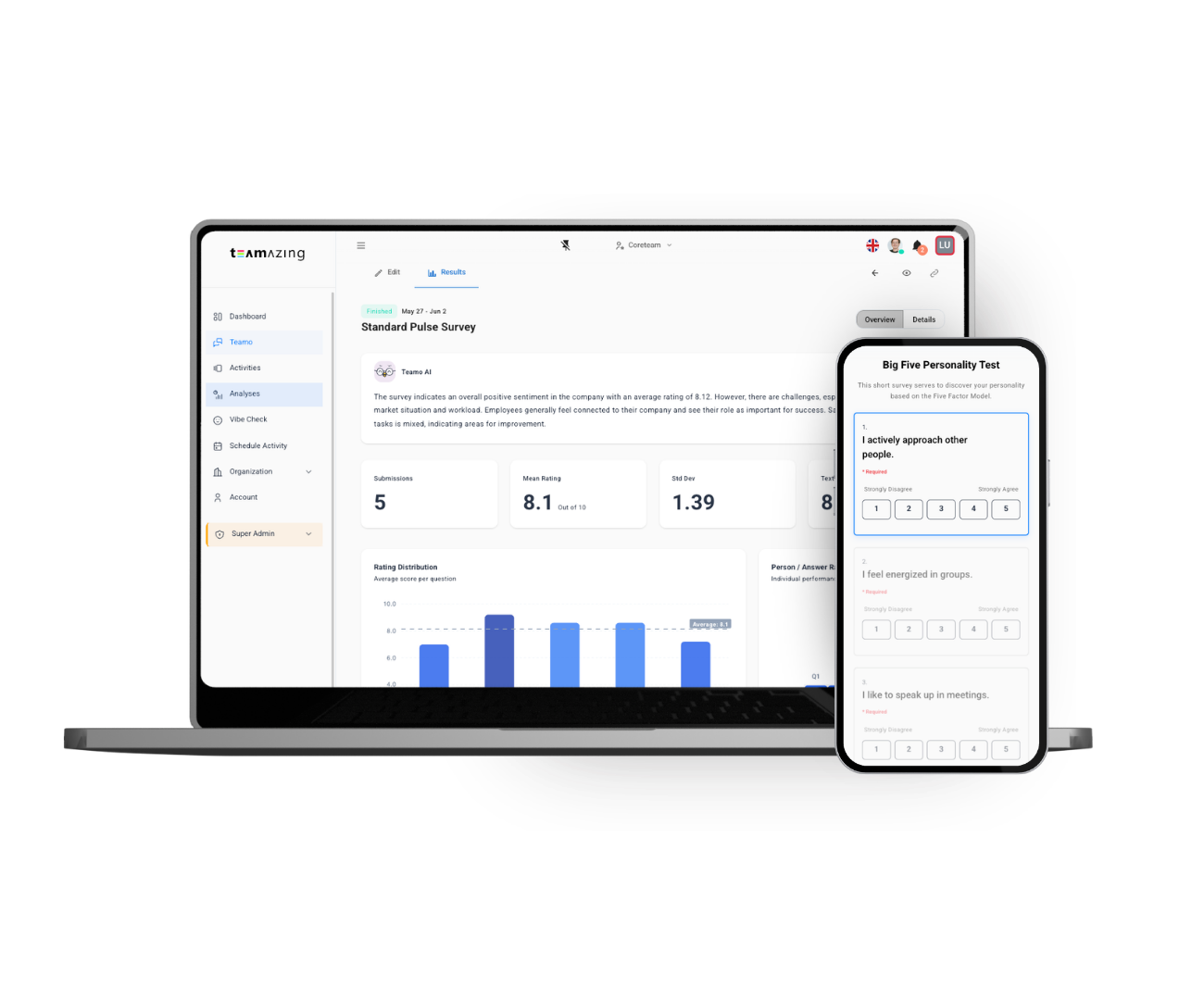
Teamo analysis platform showing survey results on laptop and mobile
Teamo AI assistant explaining analysis results

Teamo AI reads your full point distribution and writes a personal team-role narrative.

How It Works

1

Start the Analysis

Begin the potential analysis. Works for an individual or an entire team.

2

Distribute Your Points

Work through 7 sections and allocate 10 points in each. About 10 to 15 minutes.

3

Get Your Profile

Instant AI-generated profile with a radar chart, role scores and your strongest roles.

About the creators
Agentur MORE

Powered by Agentur MORE

Mag. Dr. Kristin Orthacker — business-psychology supervisor, entrepreneur and philosopher

Agentur MORE is a consultancy at the intersection of business psychology and international trade. With ambition, empathy, expertise, a pinch of humour and a strong bias for action, MORE guides organisations through holistic development — all the way to their goal.

Psychological potential analysisher own method, whose first stage this test reproduces
Supervision & coachingpsychological consulting, leadership coaching and communication training
30+ yearsinternational trade and finance management by Gerhard Merdonik
About the company

Two areas of expertise, one consultancy

Agentur MORE combines the personal and psychological aspects of entrepreneurship with experience from international trade. The consulting spans industries and company sizes — from start-ups to large corporations — and does not stop at diagnosis but at course corrections a company can actually implement.

Business psychology

Kristin Orthacker leads potential analysis, people development and team dynamics.

International trade

Gerhard Merdonik contributes finance, people leadership and strategic corporate development.

Network rather than solo consulting

Strategic partnerships open routes a single consultancy cannot cover on its own.

The three-stage MORE.Potencial method
1

Quantitative team-role survey

Team roles and dynamics are made systematically visible — the basis of this analysis.

2

Interaction-centered performance check

Body language and communication are observed and evaluated in real decision-making situations.

3

Leadership supervision

Building on Management Profile Analytics (MPA), future-oriented measures for developing potential are created.

Potential Analysis: FAQ

Ready to get started?

Create your Quick Check Potential Analysis for Leaders in minutes — free with AI-powered analysis.

Take the Test Free