



Workplace Mentoring: The Program Guide [2026]
What mentoring is, which format fits which goal, and how to build a program with measurable retention impact — incl. free 360° feedback baseline.

15 questions evaluated from 4 perspectives: self-assessment, manager, peers, and direct reports. AI compares self-ratings with others to reveal blind spots, synthesizes all feedback into a unified narrative, and generates a prioritized development plan per person.
Use This Template FreeThe difference between self-ratings and average ratings from others. 60% of leaders have at least one significant blind spot (Zenger Folkman). Over-raters need awareness building; under-raters need confidence building. AI highlights these gaps automatically.
Collecting evaluations from multiple perspectives to reduce individual bias and increase accuracy. Multi-source feedback is 2x more predictive of actual performance than manager-only reviews.
90-degree: only direct reports rate the manager (upward feedback). 180-degree: self-assessment plus manager. 270-degree: adds the peers. 360-degree: adds the direct reports for the complete picture. Each level adds a perspective and increases accuracy. In teamazing the 180, 270 and 360 variants are one-click presets.

I've analyzed the results and summarized the key themes — with actionable recommendations for your team.
360-degree feedback, also called multi-rater feedback or multi-source assessment, collects performance evaluations from all directions: self-assessment, manager (top-down), peers (lateral), and direct reports (bottom-up). This multi-perspective approach eliminates single-rater bias and provides a comprehensive view of competencies.
90% of Fortune 500 companies use some form of 360 feedback for leadership development. The key insight is the self-other gap: where your self-assessment differs significantly from how others perceive you. These blind spots are invisible without multi-rater data. Our template uses 15 questions across 5 competency dimensions, and AI synthesizes all perspectives into a unified development report highlighting strengths, blind spots, and priority growth areas.
Start using this template for free
See how others actually perceive your leadership, communication, and teamwork. The self-other gap reveals development areas invisible in self-assessment alone. Without multi-rater data, 60% of leaders miss their biggest improvement opportunities.
60% of leaders have at least one significant blind spot (Zenger Folkman). Multi-source feedback is 2x more predictive than manager-only reviews.

AI compares self-assessment with peer, manager, and direct report ratings to create a unified narrative per person. It highlights the most impactful development areas with specific behavioral recommendations, not just numbers.
90% of Fortune 500 companies use 360 feedback for leadership development. Organizations see 14.9% average performance improvement (SHRM).

Peer and direct report responses are anonymized (minimum 3 raters per group) to ensure psychological safety and honest feedback. Self-assessment and manager ratings are attributed since they are single-source. GDPR-compliant.
Anonymous peer ratings produce 40% more actionable feedback than attributed ratings.
15 LIKERT items across 5 competency dimensions plus two open questions. Every perspective answers the SAME items: the self-assessment in the first person, manager, peers (3+) and direct reports (3+) about the person. AI compares the perspectives per competency to reveal blind spots and hidden strengths.
I give clear direction.
Direction is the base of all leadership. A large self-other gap shows leaders who think they are clear but are experienced as vague.
I motivate others.
Motivation is the competency with the largest typical self-other gap: most leaders rate themselves higher than the people around them do.
I make sound decisions.
Decision quality is best judged by those who live with the consequences. Peers and direct reports see effects the manager may not notice.
I communicate clearly.
Clarity is the most common gap in 360 feedback. The perspective comparison shows whether communication lands equally well up, down and across.
I listen and take other views seriously.
Listening is experienced differently depending on the relationship. Managers often rate it higher than direct reports do, a typical power-dynamic blind spot.
I share information openly.
Information sharing is a trust indicator. Low peer scores next to high manager scores point to selective transparency.
I work well with others.
Collaboration is best measured by the peers who experience it daily. Self-ratings are typically the most inflated here.
I build relationships across teams.
Cross-team relationships reveal whether someone connects or works in a silo. The peer perspective is the most reliable source here.
I help others grow.
For development support the direct reports matter most: nobody outside can see how well someone develops their team.
I solve problems thoughtfully and creatively.
Managers see the solution, peers see the process. Only both perspectives together give the full picture.
I stay effective under pressure.
Pressure is a classic blind spot: self-ratings tend to be higher while others see the stress-driven changes.
I handle change well.
Handling change is rated differently by perspective: direct reports feel the daily effect, managers see the strategic response.
I own my results.
Accountability is the strongest predictor of leadership effectiveness in peer ratings. Self-ratings are nearly always high, the other perspectives show the reality.
I keep my commitments.
Reliability is where 360 feedback adds the most value: managers often do not see missed commitments to peers or direct reports.
I set high standards for myself and others.
Standards are experienced differently from above and below: the manager sees high standards, direct reports may experience unrealistic expectations. This gap is highly actionable.
What do I do particularly well?
What should I change?
The number of degrees only says how many directions feedback comes from. The same 15-question template works for every variant — you simply invite only the groups you need, and the analysis shows each perspective with its own scores next to the self-assessment.
Self-image + manager
The classic top-down appraisal, complemented by the self-assessment. Fast and simple, but blind to everything the manager does not see: collaboration with peers, effect on one's own team.
Set up in a day
No anonymity issue (one rater)
One single outside perspective
Often only confirms what the performance review already says
Self-image + manager + direct reports (upward feedback)
The first variant that really shows managers something: what their own manager sees and what their team experiences often lie far apart. The right entry variant for team leads in their first year.
Reveals the gap between the impression upward and downward
Less effort than 360, but already two outside perspectives
Peers are missing — interface problems stay invisible
Needs three answers from the team, otherwise no anonymity
Self-image + manager + team + peers on the same level
All internal perspectives, without externals. The variant for managers with many interfaces: the dashboard shows whether the peer view differs from the team view — typical for people who convince upward and sideways but involve their own team little. For most companies 270 degrees is the default, because customer feedback runs separately.
Complete internal picture, three outside perspectives compared
No data-protection questions with external people
At least 6–8 raters per person
Customer perspective missing for customer-facing roles
Self-image + manager + team + peers + customers or partners
The complete variant — useful for sales, key account, project leads and every role whose external effect matters. The template on this page covers the four internal perspectives; customers or partners are best asked with a separate short form on observable behavior, so they do not have to guess about internal topics like delegation.
The only variant that measures external impact
Blind spots between all five perspectives visible
Highest organisational effort, inviting externals needs sign-off
Not useful more often than yearly
| Variant | Perspectives | Raters per person | Fits | Cadence |
|---|---|---|---|---|
| 90 degrees | Self + manager | 1 | Employees without a leadership role | Yearly, in the performance review |
| 180 degrees | + own team | 4–6 | New team leads | Half-yearly |
| 270 degrees | + peers | 6–8 | Managers with many interfaces | Yearly |
| 360 degrees | + customers or partners | 8–12 | Sales, project leads, executives | Yearly |
You do not need separate software for 180 or 270 degree feedback: with the free template on this page you invite only the groups you need, and the analysis puts self-assessment, manager, team and peer view side by side per competency. AI names the gaps and writes a development report per person from them. Which questions suit which perspective is covered in the 360-degree feedback guide.
Each subject gets rated by self + manager + 3 or more peers + 3 or more direct reports. Allow 2-3 weeks for completion. The more raters, the more reliable the aggregated scores.
AI compares self-ratings with the average of all other ratings per competency. Large positive gaps (self higher than others) reveal blind spots. Large negative gaps (self lower than others) reveal hidden strengths that need confidence building.
AI combines all perspectives into a unified development report per person: strengths confirmed across all raters, blind spots where perspectives diverge, and priority areas with the highest improvement potential.
Focus on 1-2 high-impact blind spots. Schedule a follow-up 360 in 6-12 months to measure growth. Share organizational patterns across all participants to normalize the feedback culture.
Your free access to templates, survey tools, and results with ways to export anywhere.
Get Started Free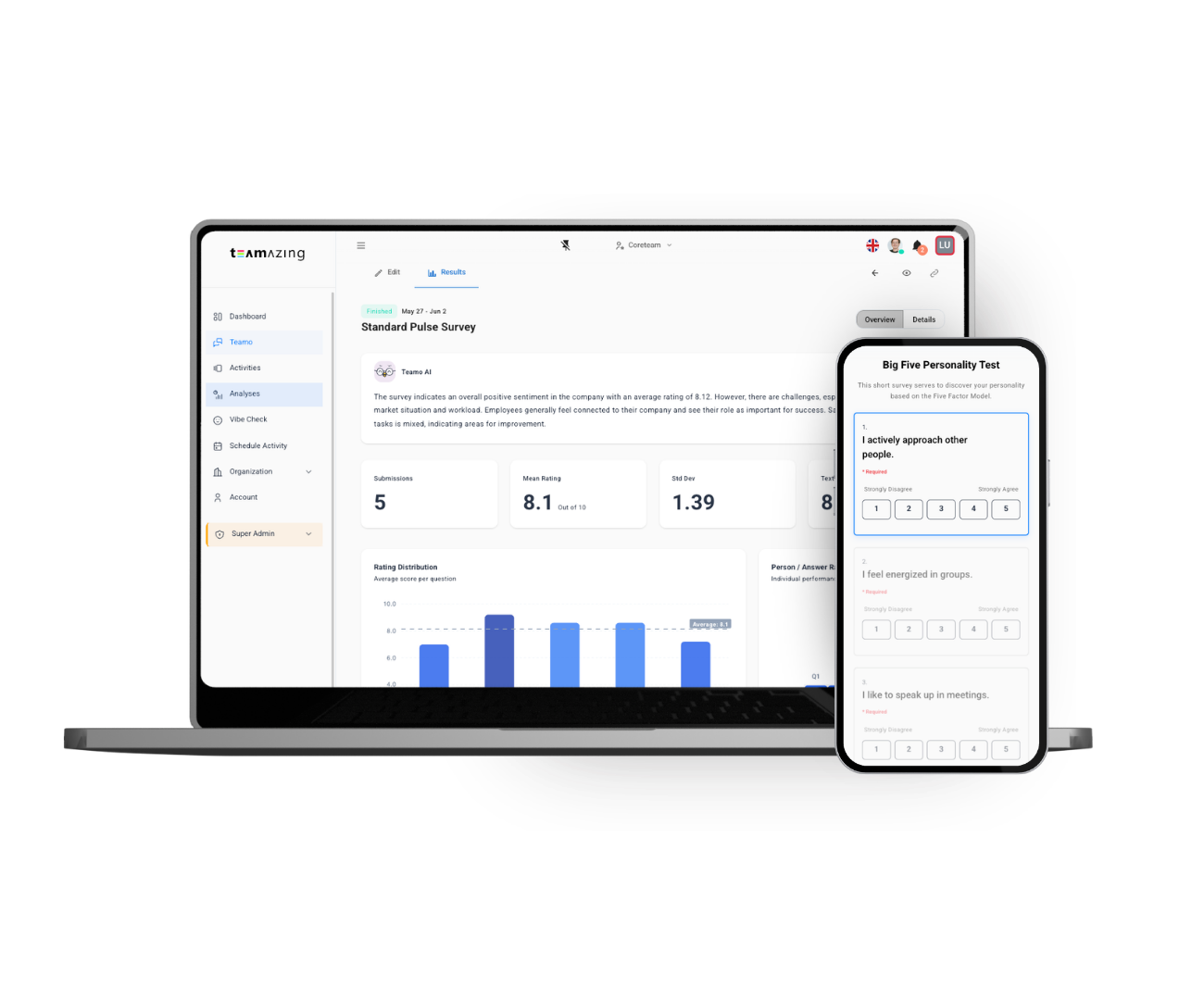
Teamo AI generates a unified development narrative per person, synthesizing all 4 perspectives into confirmed strengths, blind spots, and a prioritized action plan with specific behavioral recommendations. It also flags organizational patterns visible across all 360 participants.
One analysis evaluates one person. The template brings the four perspectives (self, manager, peers, direct reports) with 15 items each, the self-assessment worded in the first person. Name the analysis after the person and adjust items if you like.
Every perspective has its own participation link: the person gets the self-assessment link, the manager theirs, peers and direct reports theirs. Peer and direct report answers are anonymous and only shown from 3 submissions per group. GDPR-compliant.
Results show every item and competency per perspective and the self-other gap. AI turns that into a development report with confirmed strengths, blind spots and prioritized recommendations, also available to Teamo in chat.
Find the right survey template for your team
Dive deeper with these guides
![Workplace Mentoring: The Program Guide [2026]](https://www.teamazing.com/wp-content/uploads/2026/08/potential-analysis-for-leaders.jpg)
What mentoring is, which format fits which goal, and how to build a program with measurable retention impact — incl. free 360° feedback baseline.
![Feedback Forms and Templates: Which One You Need for Which Situation [2026]](https://www.teamazing.com/wp-content/uploads/2026/07/feedback-from-types-and-use.jpg)
Feedback form templates for every situation: 360 questionnaire, event and workshop feedback, customer surveys, pulse checks. Free templates and when not to use a form.
![360-Degree Feedback Questionnaire: Examples, Template and Process [2026]](https://www.teamazing.com/wp-content/uploads/2026/04/360-feedback.jpg)
A 360-degree feedback questionnaire you can use as-is: 10 example questions, a free template, rater selection, anonymity thresholds and AI-assisted analysis.
Create your 360-Degree Feedback in minutes — free with AI-powered analysis.
Use This Template Free