Powered by Cristoph Fabikan

Leadership Check: How human is your leadership, really?

Good leadership does not start with styles, orders or control, but with your attitude. Eight questions show you in five minutes where you stand as a leader today – and which of the five steps toward human leadership is your biggest lever right now.

Start the Leadership Check

This is what your result could look like

Sample result
See how it looks
Sample result

I've analyzed the results and summarized the key themes — with actionable recommendations for your team.

What the Leadership Check looks at

When something does not work in the team, most leaders look first at their employees, missing processes or external circumstances. The Leadership Check turns the question around: what can I change myself? It collects no team data, only your own answers – and uses them to show how strongly your daily work is shaped by decision, role clarity, role-modelling, time and trust.

It walks through the five steps that also form the structure of Cristoph Fabikan's practical handbook “Become a human leader”: making the decision, the new identity as a leader, being a role model, making time for leadership and believing in change. Each step is worth up to 20 points, together producing a leadership score from 0 to 100 and one of four positions – from Selbermacher to Ermöglicher.

What matters is not the number but where it comes from. Two leaders with the same score usually have entirely different challenges: one still decides everything alone, the other hands over responsibility but takes it back at the first mishap. That is why the check does not end with a figure but with the single step that carries the greatest leverage for you right now – along with a question that makes you think.

8questions from leadership practice
< 5 Minto your result
0 €free
5steps toward human leadership
Take the test now for free

What you take away

A score with an address

0 to 100, spread across five steps worth 20 points each. You see not only where you stand, but where leadership impact is created or lost.

Two or three evidenced strengths

Each derived from your own answers. “Much already works” is a valid result – the check does not invent problems.

The one lever – with a question

Not five building sites at once, but exactly one step with a page reference, a concrete description and a coaching question that invites you to reflect.

Two exercises for next week

One action and one mindfulness exercise from the handbook, doable without budget or a project plan – plus one leadership principle as your focus.

The eight questions at a glance

No scales, no agree/disagree grids, no jargon – eight questions from everyday leadership, two of them in your own words. There are no right or wrong answers; the more honestly you answer how things are today, the more useful the result.

1

Wie viele Mitarbeiter:innen führst du aktuell?

SINGLE_CHOICE
2

Beschreib deine Mitarbeiter:innen in drei Worten – die ersten, die dir einfallen.

TEXT
3

Du wünschst dir, dass dein Team mehr Verantwortung übernimmt. Was trifft heute am ehesten auf dich zu?

SINGLE_CHOICE
4

Eine Mitarbeiterin kommt mit einem Problem zu dir und fragt: „Was soll ich tun?“ Was passiert bei dir in der Regel?

SINGLE_CHOICE
5

Du wünschst dir, dass Probleme früh und offen angesprochen werden. Wie hast du zuletzt reagiert, als dir jemand etwas Unangenehmes gesagt hat?

SINGLE_CHOICE
6

Verteile 100 Punkte: Wofür geht deine Arbeitszeit in einer typischen Woche tatsächlich drauf?

‹›
Point allocation
7

Eine Aufgabe, die du abgegeben hast, geht schief. Was machst du zuerst?

SINGLE_CHOICE
8

Wenn du wüsstest, dass es gelingt: Welche eine Sache würdest du ab morgen an deiner Führung anders machen – und was hält dich bisher davon ab?

TEXT

Why leadership problems are rarely employee problems

The check takes five minutes. The logic behind it is the sequence of the handbook: five steps that build on one another. Anyone who schedules time for leadership without having made the decision manages appointments but does not lead.

1

Step 1 – Make the decision: I want to lead people

Pages 13–16

A wish is not yet a decision. “I wish my team would take more responsibility” can mean: I would like to, as long as nothing goes wrong. Or: I create the conditions and accept that I have to change something myself. The check asks about the difference – and whether your team would recognise it in daily work.

Core elements

  • Wish or decision?

  • How your team notices your decision

2

Step 2 – New identity: from specialist to leader

Pages 17–20

You are no longer just the best specialist. Anyone who solves problems faster than they could explain them takes thinking away from others with good intentions. The question of what your job really is today shows in a simple situation: someone asks “What should I do?” – and you decide whether you answer or ask.

Core elements

  • From doing it yourself to enabling

  • Not taking thinking away from others

3

Step 3 – You as a role model for what you want to experience

Pages 21–24

You do not always get what you demand – you get what you live. Your reaction is also leadership. How you react when someone raises something unpleasant early decides whether anyone does it again next time. Culture emerges through repetition.

Core elements

  • Your reaction as leadership

  • Only demanding what you live yourself

4

Step 4 – Make time for leadership

Pages 25–28

Daily business almost always wins. If leadership has to wait until everything else is done, it will probably always wait. The check has you distribute your week across 100 points: how much belongs to conversations, listening and developing your people – and how much to doing it yourself and firefighting?

Core elements

  • What you actually make time for

  • A fixed place for leadership

5

Step 5 – Believe in change

Pages 29–32

Change takes trust and time. Trust shows especially in setbacks: when a delegated task goes wrong, your first reaction decides whether responsibility stays with the people or lands back with you. That is why this question carries as much weight as the other four.

Core elements

  • Your first reaction to a setback

  • Staying clear without taking everything back

The next step

The check replaces neither a conversation with employees nor coaching. It positions one perspective – yours – and names the single step where work will pay off fastest. Anyone who wants to look closer will find the entry point in the matching step of the handbook or in a direct conversation with Cristoph Fabikan.

How to read your result

1

Look at score and position

A value from 0 to 100 and one of four positions: Selbermacher, Steuerer, Begleiter or Ermöglicher – with two or three sentences on what it means.

2

Compare the five steps

Your result per step at a glance, each with one sentence that relates to your answer.

3

Identify your biggest lever

Exactly one of the five steps is named – with a page reference, a description and a question that makes you think.

4

Take exercises, principle and case study

Two exercises for next week, one of the 11 human leadership principles and a case study that fits your team size.

Free templates, survey tools & results

Your free access to templates, survey tools, and results with ways to export anywhere.

Get Started Free
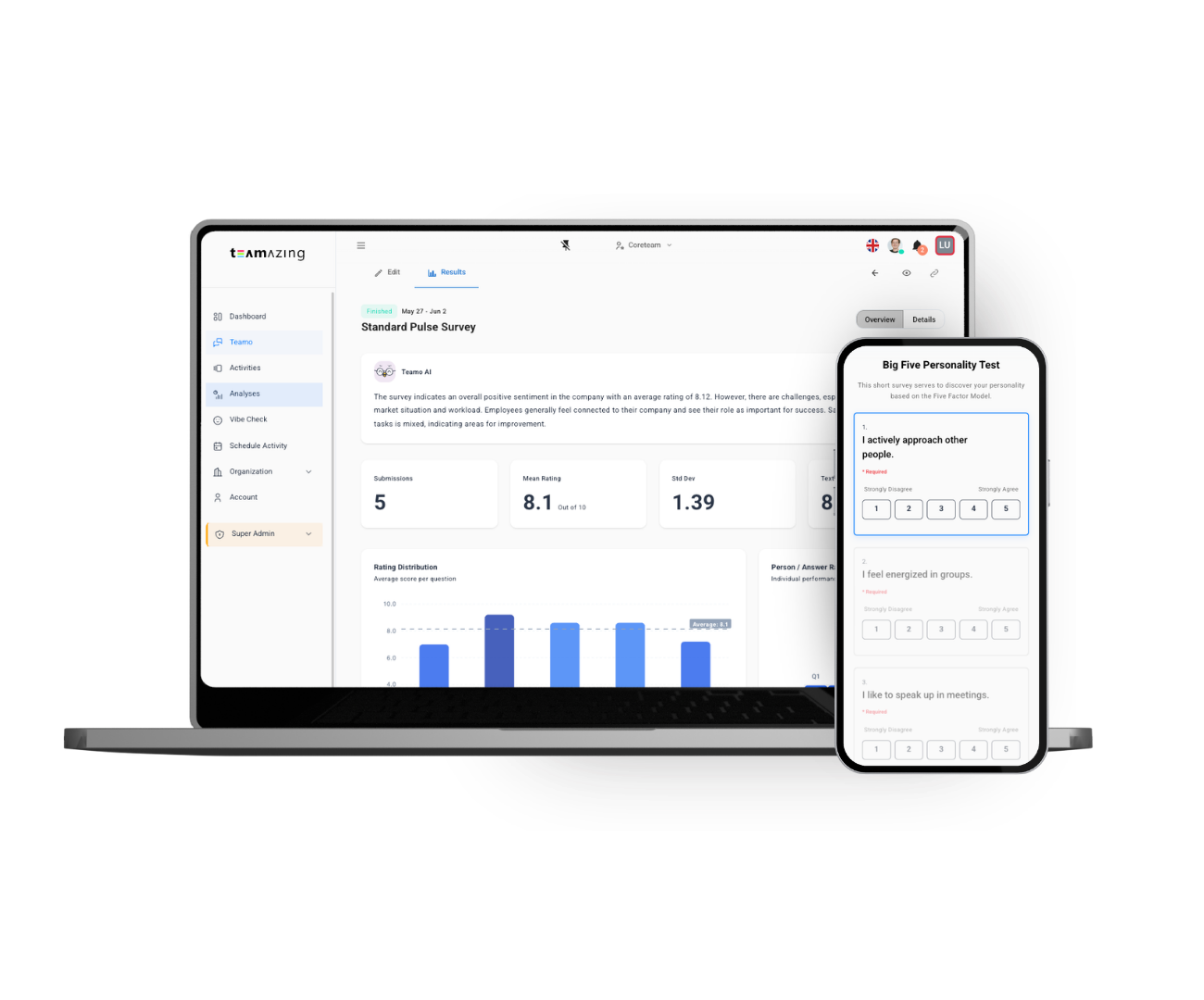
Teamo analysis platform showing survey results on laptop and mobile
Teamo AI assistant explaining analysis results

Teamo AI evaluates your answers along the five steps and writes your personal assessment from them – including the passages you phrased yourself.

How the check works

1

Answer 8 questions

Under five minutes, no preparation. Answer the way you actually experience daily work – not how it should be.

2

Read the instant analysis

Straight afterwards: your leadership score, your position, the points per step and a reflection of your own words.

3

Act on the biggest lever

One of the five steps, a question to reflect on, two concrete exercises from the handbook and one leadership principle as your focus.

4

Cross-check with your leadership team

The check shows one perspective – yours. Have other leaders take it: where the pictures diverge is usually where the real work lies.

About the creator
Belistic

Cristoph Fabikan — people need human leadership

Managing Director, BELISTIC Employer Branding Agency · author of the practical handbook „Werde zur menschlichen Führungskraft“

Cristoph Fabikan knows the step from specialist to leader first-hand: in 2011 he founded his first business as an electrician, an electrical installation company, and led it for eight years with 15 employees. With every new contract and every new team member the responsibility grew — and with it the question of how to lead people instead of doing everything yourself. For six years he has now been supporting employers with BELISTIC, mainly small and medium-sized trade and craft businesses, and has helped more than 500 owners and leaders lead in a way that makes people take responsibility. The Leadership Check turns his practical handbook „Werde zur menschlichen Führungskraft“ into eight questions.

15 employeesled himself for eight years — in his own electrical installation business
500+owners and leaders supported
Speaker of the Year 2026Speakernight Vienna, keynote “Human Leadership – Wie man Menschen gewinnt?”
About the company

BELISTIC — human recruiting and leadership for employers

BELISTIC is an employer branding agency from the Weinviertel region that thinks leadership and recruiting together: good people apply and stay where they are led humanely. The work starts with the leader's own attitude rather than with methods and tools. At its heart is the employer seminar — four seminar days at Seminarhotel Klaus in Wolkersdorf, in a deliberately small group of around five to ten people, where owners and managing directors develop their role as a human leader, including a roadmap for implementation. Leadership coaching, keynotes and online courses on the hiring process complete the offering.

The five steps from the practical handbook „Werde zur menschlichen Führungskraft“
1

Make the decision

A wish keeps options open, a decision sets the direction: I want to lead people — and my team notices it in daily work.

2

From specialist to leader

Success no longer shows in how much you solve yourself, but in how much can be solved without you.

3

Be a role model

Culture grows through repetition. Your reaction — including to bad news — is leadership too.

4

Make time for leadership

Leadership does not wait until the daily business is done: it gets a fixed place in your week.

5

Believe in change

Trust shows in setbacks. New leadership grows through repetition and takes time.

Frequently asked questions about the Leadership Check

Ready to get started?

Create your Führungskräfte-Check in minutes — free with AI-powered analysis.

Take the Test Free