



Overwhelmed as a Manager: 10 Warning Signs and a Plan for This Week
Overwhelmed as a manager? 10 warning signs, how to tell if it is you or the role, a 5-step plan for this week and a free 2-minute stabilisation check.

 By RIECON · Christian Rieger
5 questions, about 2 minutes, free. You see straight away whether you are short of space, decision clarity, energy or the right resources — and what a sensible next step looks like. Developed by stabilisation manager Christian Rieger (RIECON, Graz).
Start the checkThis is what your result could look like
 See how it looks
People who carry responsibility are often the last to notice overload. The day is full of operational fires, decisions pile up, energy drops — and from the outside everything still looks stable. The Stabilisation Check is a short self-assessment for managing directors, owners and leaders in key positions. It does not ask about personality but about your current situation: do you have enough room to act? Can you decide with confidence? Do you stay effective under pressure? Do you have access to the right resources? And how stable does your organisation feel overall? From your answers the check calculates five scores from 0 to 100 and shows which area offers the biggest lever right now. It is not a burnout test or a medical diagnosis — it is an honest status check.
Take the test now for freeUnder pressure everything feels equally urgent. The check shows which of the five areas is weakest — that is where the first step pays off most.
5 areas, 1 focus
Your scores are calculated from your answers by fixed rules. The same answers always give the same result; the AI only writes the interpretation.
Scale 0–100
Not a list of measures but one recommendation that fits your result — up to a free, confidential walk & talk at Hilmteich lake in Graz.
30-min walk & talk
You rate each statement on a scale from 1 (does not apply) to 5 (fully applies). Answer as things are today — not as they should be.
I currently have enough space to focus on what matters most.
I can currently make important decisions with clarity and confidence.
Even under pressure I stay clear, energized and able to act.
I have access to the right resources and experts when I need them.
Overall, I currently experience my organization / leadership role as stable and capable of acting.
Overload in leaders rarely shows up as one big event. It starts in one of five areas and spreads from there. Knowing the area lets you counter it deliberately.
When day-to-day business leaves no time for what matters
The most common pattern: the leader keeps absorbing operational tasks and unplanned events — a missing key person, an escalating project, a production bottleneck. Strategic topics get postponed until they become a problem themselves.
Your calendar belongs to others, not to you.
Strategic work happens in the evening or at weekends.
You are the last resort for almost every problem.
When important decisions stall or are made too fast
Under pressure, decisions are either postponed or made on gut feeling. Both are costly: delay paralyses the team, snap decisions create correction loops. It helps to consciously assess how much effort a decision needs — some can be made quickly, some need reflection with head, gut and heart, some need outside expertise.
The same decision reappears week after week.
You second-guess decisions afterwards.
The team waits for you before it can continue.
Whoever can lead themselves can lead others
Exhaustion starts quietly: sleep gets worse, patience shorter, communication terser. Leaders are often the last to admit it. Self-leadership means consciously steering your own state — through self-management, handling strain and clear communication. The goal is self-efficacy, not permanent support.
You react more irritably than before.
Weekend recovery is no longer enough.
Clarity only comes in rare moments.
When the right support is missing or arrives too late
Many crises are solvable, just not alone. The problem is rarely a lack of budget but a lack of access: who knows exactly this topic, and who is available at short notice? Without a network, the solution stays with the person who is already overloaded.
You search for specialists yourself instead of deciding.
Know-how depends on individual people.
Outside help only arrives when things escalate.
Spotting early signs before a turnaround is needed
Company crises usually announce themselves long in advance — rarely in the numbers first, often in the people: key people are exhausted, decisions concentrate at the top, conflicts increase. Assessing overall stability honestly and early keeps room for action. Even a well-positioned organisation benefits from a neutral assessment, for instance before changes or acquisitions.
Key people drop out or resign.
Projects regularly overrun time and budget.
Important topics are only handled reactively.
| Weakest area | What is missing | Matching option |
|---|---|---|
| Relief | Time and room to act | Relief management / acute interim management |
| Decisions | Structure and confidence | Decision management |
| Self-leadership | Energy and clarity | EMPEX® coaching |
| Resources | Suitable expertise | Expert network |
| All areas 70+ | Foresight | Smart Impact Audit® |
The mean across all five areas — a first indication of how much reserve you have right now.
If an area is at 40 or below, it is your bottleneck. That is where the recommendation starts.
Then you are currently well stabilised. The recommendation is a forward-looking assessment rather than an acute measure.
Your free access to templates, survey tools, and results with ways to export anywhere.
Get Started Free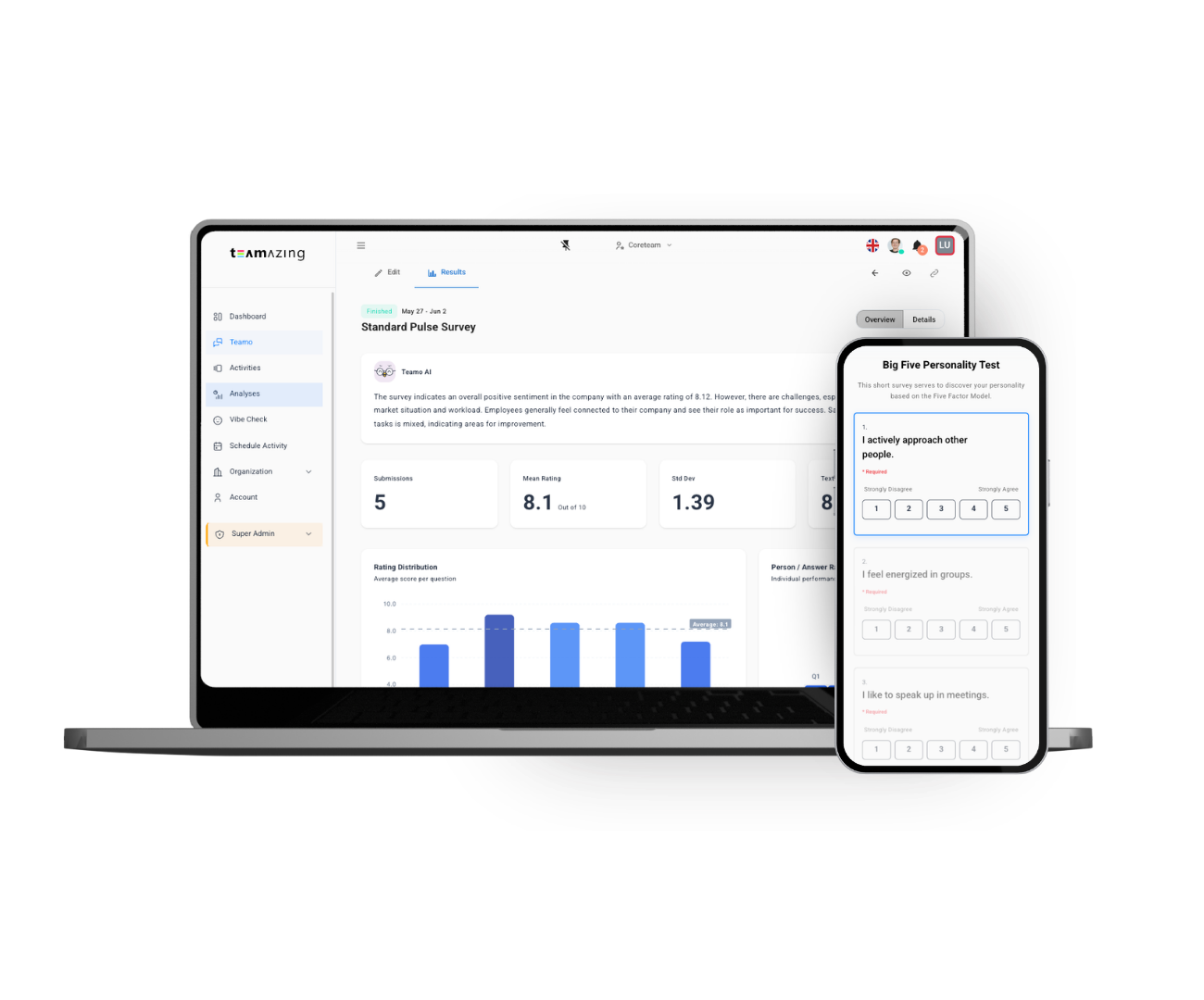

Teamo AI turns your calculated scores into an interpretation in everyday language. The numbers themselves never come from the AI.
One statement each on relief, decisions, self-leadership, resources and overall stability. No account, no registration.
You get your stability score and five individual scores from 0 to 100.
A short, personal analysis explains where your biggest lever is and why.
If you wish: a confidential conversation with Christian Rieger — no sales pressure.

DI (FH) Christian Rieger, M.Sc. — stabilisation manager, crisis & acute interim manager
Christian Rieger is a technician and engineer and has been a project manager, division head, managing director, entrepreneur and liquidator. For more than 25 years he worked in mechanical engineering and the vehicle and mobility industry, including at Siemens, KTM and AVL List, and spent over 14 years as CEO of the high-tech company SinusPro GmbH. Many years ago he burned out as a leader himself. That experience shaped what he does today: giving people in key positions space and stability where a lot is happening at once — listening before offering solutions, creating clarity where it is missing and, when needed, rolling up his sleeves. A head-and-heart decision-maker who does not believe in one-size-fits-all recipes.
RIECON — Christian Rieger Consulting e.U. from Graz works with managing directors, owners and leaders in key positions, mainly in technology and mobility companies. Stabilisation management combines four building blocks: relief management (“Create room. Secure stability.”) with temporary hands-on support up to acute interim management, decision management (“Create clarity. Decide with confidence.”), EMPEX® coaching — Empowerment for Executives (“Regain strength. Act with self-efficacy.”) and the expert network (“The right resources. Fitting solutions.”). This is complemented by the Smart Impact Audit®, developed together with the University of Vienna, as a forward-looking assessment — including ahead of change or acquisitions. Christian Rieger is a member of DÖIM (the Austrian interim management association), the Silicon Alps Cluster and the Wirtschaftsforum der Führungskräfte, and a trainer at the AC Styria mobility cluster academy.
Hands-on support where it is missing right now — at the highest level, stepping directly into day-to-day business at short notice.
“I do not take the responsibility off your hands. I create the framework and the basis for the decision.”
Self-management, state management, leadership and communication — the goal is self-efficacy, not permanent support.
First clarify what is needed — then bring in one of more than 100 experts, advising or working in the company for a limited time.
Developed with the University of Vienna: confidential interviews, a deviation matrix and an action workshop — making tensions visible before they escalate.
A walk. A confidential conversation. A first step. 30 minutes, free, not a sales pitch.
Take the pressure off your shoulders — through temporary relief or EMPEX® coaching.
Look at the situation in a structured way: what is really urgent, what is important?
Bring in the right expertise from a network of more than 100 experts where needed.
Use the RIECON decision compass to consciously assess how much effort a decision needs.
Until you act confidently on your own strength again — the responsibility stays with you.
Built by experts or ready-made templates — find the right test for your team
Dive deeper with these guides

Overwhelmed as a manager? 10 warning signs, how to tell if it is you or the role, a 5-step plan for this week and a free 2-minute stabilisation check.

The three strategy families behind self-leadership, what 16,493 observations say about their effect, where the concept is oversold, and how to measure your own.

Manager burnout is a state of chronic exhaustion caused by the unique pressures of people leadership: accountability for team outcomes without adequate tools, visibility, or support. Learn why 75% of middle managers report extreme burnout, 8 warning signs, a 5-step prevention framework, and how AI reduces manager workload without adding meetings. Free manager effectiveness assessment included.
Create your RIECON Stabilisierungs-Check in minutes — free with AI-powered analysis.
Take the Test Free