



Sales Process: Map the Buying Side, Not Your Own Steps
The seven phases of a sales process, why stage definitions decay, the handover points where deals die, and how to tell a real stage from a wish.

 Powered by Kurt Zechner, MBA
9 questions, about 5 minutes. You get an instant assessment across six sales dimensions and the one lever you should start with. Powered by Kurt Zechner, MBA.
Start the Quick CheckThis is what your result could look like
 See how it looks
The VCC Quick Check is the short self-assessment version of Kurt Zechner's Vertriebs Competence Check. The full VCC is a management instrument: 94 questions, 18 sub-dimensions, collected anonymously and separated by team, evaluated in a 42-page management report. This Quick Check condenses the same model into nine questions. You rate everyday situations rather than jargon: what happens when a new lead comes in, what happens when a competitor is cheaper. The result is a profile across all six dimensions, an overall score on a scale of 1 to 10, and the one dimension where work pays off fastest for you.
Take the test now for freeSix dimensions with a score and a traffic-light colour. No grades, no consultant jargon.
9 questions, instant result.
The check prioritises for you and names the first concrete step.
Self-rating and lived reality combined.
Where your rating is good but you still recognise the problem from daily work, it gets named.
The strongest aha moment of the evaluation.
Ten points spread across the sales week show how much of it is selling time at all.
Its own evaluation block.
Nine questions. Five are 1 to 10 scale questions, one is a situation checklist, two are distribution questions and one is free text. All describe everyday situations, no jargon.
Which of these situations do you recognise from your sales work? (Multiple answers possible)
If I ask three people from our sales team which customers and topics have priority, I get the same answer three times.
When a new lead comes in, it is clear without asking who takes it over and what happens next.
I could say right now – without asking anyone – how much revenue is currently in our pipeline.
Every person in our sales team had a one-on-one with their manager about goals, performance or development in the last four weeks.
If a salesperson is absent tomorrow, a colleague finds everything in the CRM to seamlessly continue serving their customers.
Think of a typical first conversation with a new potential customer: how are time and focus typically distributed?
Distribute 10 points: where does your sales team currently spend most of its time?
Is there any other information that could be relevant for the sales check?
Anyone building or restructuring a sales organisation usually starts with the org chart — inside sales, field sales, territories and reporting lines. The VCC reverses that order: it first assesses how well the organisation performs across six dimensions, and only from that does it follow what structure is actually needed. The quick check condenses this model into nine questions and rates each dimension on a scale of 1 to 10.
Dimension 1 of 6 · scale 1–10
This dimension asks whether your organisation works a market or reacts to it. In technical B2B the difference matters especially because project cycles are long: whoever only reacts once the enquiry arrives is no longer present at specification stage — and ends up negotiating price alone. A strong score shows in target markets, ideal customers and your own position being nameable without anyone having to look them up.
Target markets and ideal customers are defined, not historically grown
The position versus competitors is known within the team
Sales is present at specification stage, not only at quotation
Dimension 2 of 6 · scale 1–10
This is where it is decided whether your sales organisation works as a system or as a sum of individuals. The test question is deliberately mundane: when a new lead comes in, is it clear without asking who takes it and what happens next? Where that clarity is missing, the typical friction between inside and field sales appears — and that interface is the most common bottleneck in technical B2B.
Responsibilities for new leads are clear without asking
Inside and field sales work one process, not side by side
The process works during holidays and sickness too
Dimension 3 of 6 · scale 1–10
The test of this dimension is a single statement: I could say right now how much revenue is currently in our pipeline. If you first have to trigger a report, you are steering in hindsight. Sales metrics do not exist to explain the quarter but to influence it while it is still running — which is why availability counts for more than granularity here.
The pipeline value is available any time, not just at month end
There are leading indicators, not only revenue in hindsight
The numbers are used to steer, not only reported
Dimension 4 of 6 · scale 1–10
In the full VCC this is the dimension with the largest perception gaps. Because leadership, field sales and inside sales answer separately there, what an overall average hides becomes visible: where assessments diverge by 1.5 points or more, a perception gap is reported. An organisation where leadership rates 8 and field sales rates 5 does not have a leadership problem in the sense of too little — it has a problem with leadership not arriving.
There are regular development conversations with sales content
New hires have a structured onboarding
Leadership is perceived similarly by inside and field sales
Dimension 5 of 6 · scale 1–10
This dimension does not measure how many tools are in use but where sales time flows. The quick check asks you to distribute ten points across the team's activities. The result is regularly surprising: in many technical B2B organisations the largest share goes into preparing quotes and internal coordination, not customer contact. A CRM only improves this score if it takes work away rather than being documented on top.
The largest share of time is with the customer, not in administration
Tools take work away instead of doubling it
Knowledge sits in the system, not exclusively in people's heads
Dimension 6 of 6 · scale 1–10
The last dimension looks into the first meeting: how do time and focus divide there? Where most of it goes to your own offering, the meeting is a presentation. Where it goes to the customer's situation, it is a sales conversation. In technical B2B the temptation to tip into presentation mode is particularly strong — the solution is explainable, and explaining feels productive.
In the first meeting the customer's situation outweighs your own offering
The need is established before a solution is shown
Objections are worked through, not talked over
| VCC Quick Check | Vertriebs Competence Check | |
|---|---|---|
| Scope | 9 questions, 6 dimensions | 94 questions, 6 dimensions, 18 sub-dimensions |
| Who answers | You yourself | Leadership, field sales and inside sales, separately and anonymously |
| Perception gaps | Not measurable — there is only one perspective | Deviations from 1.5 points are reported as a gap |
| Result | Profile across six dimensions, an overall score and your biggest lever | 42-page management report with prioritised fields of action |
| Effort | 5 minutes, free | Survey inside the company, personally interpreted by Kurt Zechner |
Both versions use the same traffic-light logic: below 5.0 there is clear need for action, between 5.0 and 7.4 the dimension has room to grow, from 7.5 it is a strength. The quick check gives you that classification for six dimensions and names the one where work pays off fastest. What it cannot do is answer the question that usually decides things in technical B2B: whether leadership, field sales and inside sales see the same organisation. That needs the separated survey — which is exactly why the quick check is designed as an entry point and not a replacement. How to derive a structure from such a profile is covered in Build a sales team; which metrics carry the steering, in Sales KPIs.
Mean across all six dimensions on the 1 to 10 scale, with a traffic-light dot.
Six axes, the same hexagon view as in the full VCC.
The weakest dimension with a concrete first step.
Your sales week and your first conversation as bars, with the share of active selling time.
Your free access to templates, survey tools, and results with ways to export anywhere.
Get Started Free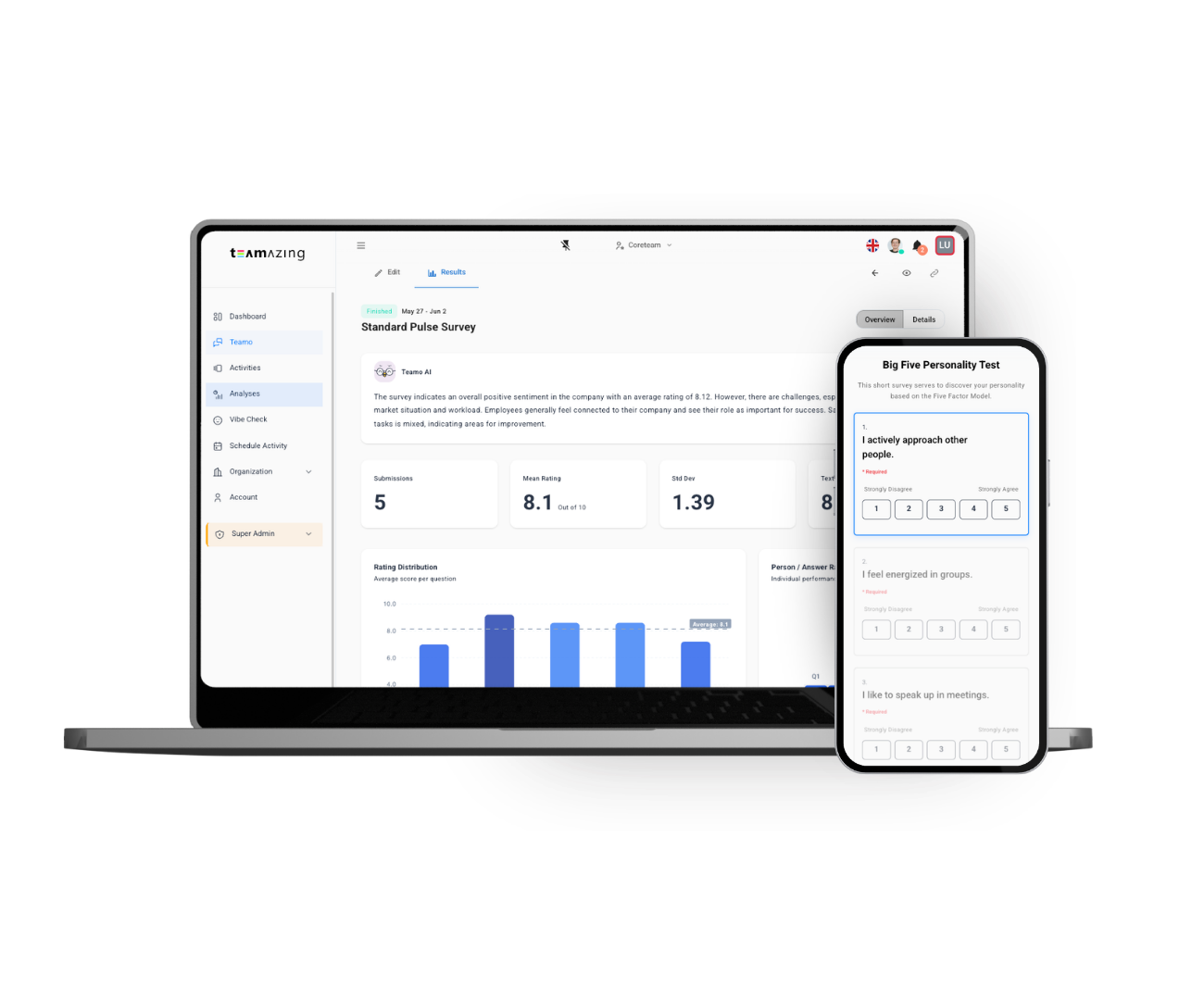

Teamo AI connects your scores, the situations you recognised and your own additions into a plain-language interpretation.
Right here on this page, without preparation.
Everyday situations rather than jargon, about five minutes.
Overall score, hexagon across six dimensions and your biggest lever.

Kurt Zechner, MBA — sales coaching for technical B2B sales
Kurt Zechner, MBA brings over 30 years of experience in B2B sales and sales leadership, 15 of them in a leading role in the metalworking industry. As founder of vertriebscoaching.at he helps managing directors and sales leaders in technical B2B environments make sales success predictable. His guiding principle: you do not need luck to sell successfully, only the right plan and coaching as equals.
vertriebscoaching.at is aimed at managing directors and sales leaders in technical B2B environments. The guiding principle: you do not need luck to sell successfully, only the right plan and coaching as equals. Accordingly the work does not start with the org chart but with how well the sales organisation actually performs across six dimensions.
Leadership, field sales and inside sales answer anonymously and separately.
Where assessments diverge by 1.5 points or more, that is explicitly reported.
Below 5.0 needs action, 5.0 to 7.4 has room to grow, from 7.5 it is a strength.
Market & strategy, organisation & processes, performance & metrics, leadership & development, digitalisation and customer experience are surveyed across 18 sub-dimensions.
Leadership, field sales and inside sales answer separately. Where the assessments diverge by 1.5 points or more, a perception gap is reported.
The result is a 42-page report with prioritised fields of action, which Kurt Zechner interprets personally and discusses with you.
Built by experts or ready-made templates — find the right test for your team
Dive deeper with these guides

The seven phases of a sales process, why stage definitions decay, the handover points where deals die, and how to tell a real stage from a wish.
![Building a Sales Team: Everything Except the Hire Comes First [2026]](https://www.teamazing.com/wp-content/uploads/2026/08/vertriebsteam-aufbauen.jpg)
How to build a sales team: which structure to decide before hiring, when each role earns its cost, why onboarding rather than recruiting is the bottleneck at 6.2 months of ramp, how to hire for the gap instead of copying your best seller, and when leadership becomes the constraint. Includes a free five-minute check.
![Sales KPIs: 8 That Explain Something, 5 That Only Look Busy [2026]](https://www.teamazing.com/wp-content/uploads/2026/08/performance-management.jpg)
Which sales KPIs actually predict results: eight metrics worth steering by, five that only look busy, how to split leading from lagging, and how to build baselines from your own four quarters instead of chasing published benchmarks. Includes a free five-minute structural sales check.
Create your VCC Quick Check in minutes — free with AI-powered analysis.
Take the Test Free