



Company Vision Statement: The 12 Questions That Make One Stick
A working method for developing a company vision: 12 guiding questions, a two-day workshop agenda, real examples, and how to check whether yours actually carries.

 Powered by GUSSMAGG
Reflect the clarity of your future across six central dimensions and discover where your biggest lever for orientation, communication and implementation lies. Powered by GUSSMAGG VISIONPICTURES.
Start the Vision CompassThis is what your result could look like
 See how it looks
The Vision Compass, powered by GUSSMAGG VISIONPICTURES, is a free readiness check for transformations. Transformations rarely fail for lack of ideas — more often a shared understanding of where the journey should go is missing. Different inner images lead to misunderstandings, friction and declining identification. In this self-assessment you rate eighteen statements across six dimensions on a scale of 1 to 5. The result is a radar profile of your future clarity and the landscape that best describes where your organisation stands today.
Take the test now for freeThe radar makes the strong and the weak dimensions of your future clarity visible at a glance.
Six dimensions, one clear picture.
A rule-based logic matches your scores to one of seven landscapes with a concrete recommendation.
From The Fog Walk to The Free High Trail.
Compare individual profiles to reveal where inner images of the future diverge.
Shared clarity reduces friction.
Teamo AI turns your dimension scores into a clear narrative and names the biggest lever.
Results are ready immediately.
Six dimensions, three statements each. You rate every statement from 1 (does not apply at all) to 5 (fully applies). Each dimension score is the average of its three statements.
Our leaders can describe the future of our company clearly and understandably.
Employees would explain the key goals of our transformation in a similar way.
Our future is more than a presentation — it creates concrete mental images.
Current projects can be clearly connected to our strategic goals.
In decisions it is recognisable which direction the company is pursuing.
The priorities of the coming years are understandable to most employees.
Employees understand why changes are necessary.
The future generates motivation rather than uncertainty.
People recognise their own contribution to achieving the goals.
Our strategy can be explained in less than three minutes.
Complex topics are communicated understandably.
Leadership conveys a consistent message.
The most important initiatives are visible and comprehensible.
Progress is communicated regularly.
There are shared images, symbols or stories for the future.
The strategic goals influence daily actions.
Cross-departmental collaboration supports the transformation.
There is little friction between strategy and implementation.
If your transformation were successfully completed: what would customers see immediately?
What story should employees tell about your company in three years?
Which image best describes your future? (e.g. expedition, mountain climb, sea voyage, city of the future, production line, ecosystem or another image)
A company vision rarely fails because it is missing. It fails because it is understood differently by different people. That is what the Vision Compass measures: it breaks future clarity into six dimensions and rates each with three statements on a 1-to-5 scale. Below you will find every dimension with its core elements and a typical everyday situation — followed by the seven landscapes your profile can be matched to.
Dimension 1 of 6 · 3 statements · scale 1–5
A future picture is not the sentence on the slide but the image everyone carries when that sentence is spoken. The difference becomes visible the moment two departments are asked to describe the same future independently: if two different stories come out, the vision exists as wording but not as a shared picture. This is exactly where GUSSMAGG VISIONPICTURES starts — abstract strategies are translated into visible images, because information alone no longer suffices at this point.
Leaders describe the future clearly and understandably
There is a shared picture, not just shared wording
Two departments independently tell the same future
New joiners can retell the picture after a few weeks
Dimension 2 of 6 · 3 statements · scale 1–5
Orientation is the link between the future picture and what is in this week's calendar. It is high when running projects connect clearly to the strategic goals — and low when that connection can only be made on request and only by the management team. Weak orientation alongside a strong future picture is one of the most common patterns: everyone knows where things are heading, nobody knows what that means for their own area.
Current projects connect clearly to the strategic goals
The connection can be explained without the management team
Priorities are decidable when two initiatives collide
New initiatives are checked against the goals, not just the budget
Dimension 3 of 6 · 3 statements · scale 1–5
Identification measures whether people understand why change is necessary — not whether they agree with it. The difference matters: agreement cannot be forced, understanding can be created. Where identification is missing, transformation is experienced as something that happens to the company rather than something it does. High identification with weak implementation power produces the landscape “The Blocked Mountain Pass”: people want to, the system will not let them.
People understand why changes are necessary
The benefit of the change can be named at team level
Resistance shows up as a question, not as withdrawal
The future is experienced as an own task, not a top-down instruction
Dimension 4 of 6 · 3 statements · scale 1–5
The hardest test of this dimension is a time limit: can your strategy be explained in under three minutes? What takes longer does not get retold — and what does not get retold does not exist in daily work. Weak communication alongside a strong future picture produces the landscape “The Echo in the Valley”: leadership knows the direction, the message loses its effect on the way down. The lever is rarely more communication but a different form — images, stories and symbols instead of more slides.
The strategy can be explained in under three minutes
It is retold by employees, not just broadcast by leadership
There are recognisable images, terms or symbols
The same message holds on the shop floor and in the boardroom
Dimension 5 of 6 · 3 statements · scale 1–5
Visibility is the most underrated dimension. It does not ask whether a lot is happening but whether what happens is noticed. If it drops below 3.0 the landscape “The Hidden Base Camp” already applies: a lot is moving in the organisation, but progress and successes stay invisible. The result is a climate in which transformation feels endless, because nobody can see any interim state.
The most important initiatives are visible and traceable
Interim states are shown, not only end results
Successes can be attributed to specific teams
There is one place where progress physically or digitally lives
Dimension 6 of 6 · 3 statements · scale 1–5
Implementation power asks whether the strategic goals influence daily action — not whether they are achieved. It is the dimension that decides whether future clarity turns into movement. Two patterns are especially common: a high future picture with low implementation power gives “The Summit in the Fog” — the goal is visible, the path is not. High orientation and identification with low implementation power gives “The Blocked Mountain Pass” — then it is structural obstacles, not missing clarity.
The strategic goals influence daily action
There are decisions that turned out differently because of the strategy
Resources are shifted along the goals, not merely added
Obstacles are named rather than worked around
| Landscape | What the profile shows | The next step |
|---|---|---|
| The Free High Trail | Vision, orientation and implementation interlock. The organisation moves forward with clarity. | Use the momentum and anchor the future permanently in culture and leadership. |
| The Blocked Mountain Pass | The direction is clear, people understand the purpose, yet implementation stalls. | Identify and remove structural obstacles. |
| The Fork in the Road | The energy is there, but different areas interpret the future differently. | Translate strategy and vision into a shared language and create orientation. |
| The Summit in the Fog | The goal is visible, the path unclear. The vision is not yet translated into concrete steps. | Develop a transformation map and make the path to the vision visible. |
| The Echo in the Valley | Leadership knows the direction, the message does not arrive equally everywhere and loses effect. | Translate complex strategies into understandable images, stories and symbols. |
| The Fog Walk | The organisation is on its way but without a sufficiently clear shared future picture. Interpretations create friction. | Develop a shared future picture and make strategic priorities visible. |
| The Hidden Base Camp | A lot is happening in the organisation, but progress and successes remain largely invisible. | Make the transformation visible and create points of orientation. |
Anyone setting out to develop a company vision usually starts with the wording. The Vision Compass suggests looking elsewhere first: in the vast majority of profiles the future picture is not the weakest dimension — communication, visibility or implementation power is. New wording repairs none of those three. That is why the result does not simply name the lowest score but the dimension that needs clarity first so the others can take effect at all. How a vision fails and what carries instead is covered in depth in Company vision: why most visions fail. Translating it into visible future pictures — workshops, wall murals, graphic recording — is the craft of GUSSMAGG VISIONPICTURES: expression makes an impression.
Rate every statement from 1 to 5 across the six dimensions.
Each dimension is the average of its three statements, plotted on the radar.
A rule-based logic matches your scores to one of seven landscapes.
The recommendation names the dimension that needs clarity first.
Your free access to templates, survey tools, and results with ways to export anywhere.
Get Started Free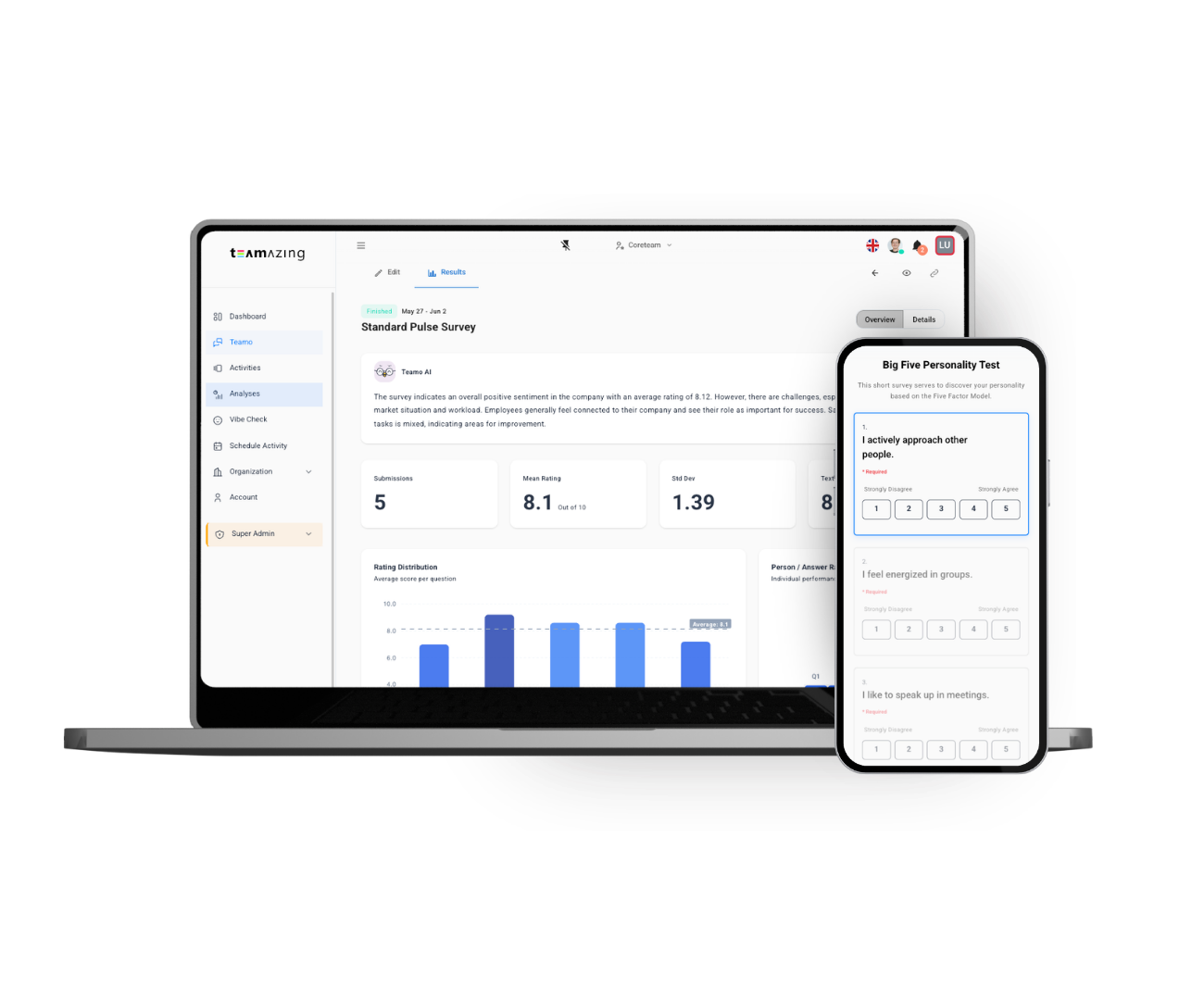

Teamo AI reads your dimension scores and writes a personal readiness narrative.
Begin the readiness check. Works for an individual or an entire leadership team.
Rate 18 statements from 1 to 5 across six dimensions. About 8 to 12 minutes.
Instant AI-generated profile with a radar chart, your landscape and the biggest lever.
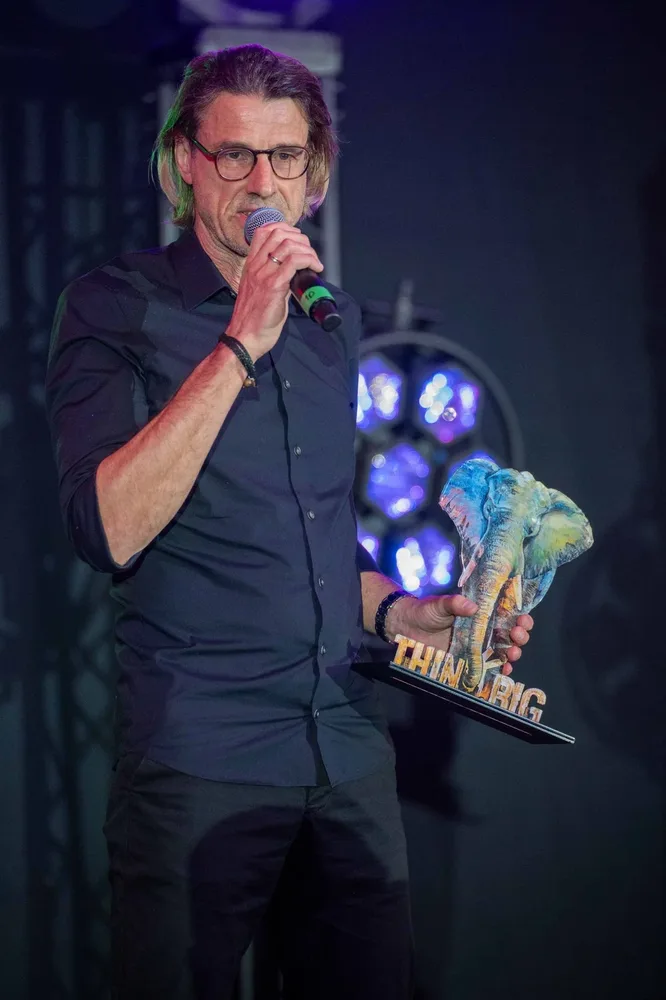
Reinhard Gussmagg — artist, management consultant and speaker
GUSSMAGG VISIONPICTURES helps organisations translate abstract goals into shared, understandable and motivating pictures of the future. Expression makes an impression.
GUSSMAGG VISIONPICTURES works at the intersection of business and art. Where information alone is no longer enough, pictures emerge: future pictures that make a strategy tellable, and formats that translate complexity into symbols, stories and scenes. Clients range from automotive suppliers to innovation-driven technology companies.
Scenarios are developed with the team and translated into a shared picture in the room.
Large-format pictures keep the future picture permanently visible in the company.
Conferences and strategy days are drawn live rather than merely minuted.
Abstract strategies are translated into concrete, visible images that provide orientation.
Complex messages are brought into a shared language of images, symbols and stories.
Shared pictures of the future create identification and carry the transformation into everyday work.
Built by experts or ready-made templates — find the right test for your team
Dive deeper with these guides

A working method for developing a company vision: 12 guiding questions, a two-day workshop agenda, real examples, and how to check whether yours actually carries.

A company vision is a vivid, long-term picture of the future your organization wants to create. Most visions fail not because they are badly written, but because nobody knows them, they fit any company, and they never change a single decision. This guide explains the difference between vision, mission, guiding principles, and strategy, shows the research on the vision-execution gap, and gives you a free self-test (Visionskompass) to measure how clear your vision really is before you cascade it to your teams.
![Free Leadership Assessment Test: 7 Tools, No Signup [2026]](https://www.teamazing.com/wp-content/uploads/2026/08/test-for-leaders.jpg)
Free leadership assessment test, checked in 2026: 7 tools that are genuinely free, no signup, plus what Birkman, CliftonStrengths and Korn Ferry actually cost.
Create your Visionskompass in minutes — free with AI-powered analysis.
Take the Test Free