





Powered by Robert Mack Consulting

Sales potential check: where does your sales function really stand?

12 questions, about 5 minutes. You get an instant result across seven sales fields and your two biggest levers. Powered by Robert Mack Consulting.

Start the check

This is what your result could look like

Sample result
See how it looks
Sample result
Performance factor78%

The mean across all seven fields: a single number from 0 to 100 for the maturity of your sales.

The two biggest levers+42

Not simply the two weakest scores, but the fields where a low score and your own felt pain coincide.

Self-image and outside view84%

The same check filled in by colleagues. The divergence is often more revealing than your own score.

I've analyzed the results and summarized the key themes — with actionable recommendations for your team.

What is the Sales Potential Check?

The Sales Potential Check is the short self-assessment version of Robert Mack's Vertriebspotenzial-Check, a structured rapid analysis of a company's sales situation. The full version is run by an expert in a personal conversation and rates seven performance areas against the company vision. This online check covers the same seven fields but needs only twelve questions. You answer situations from your everyday work rather than technical terms: what happens when an ill-fitting enquiry comes in, what happens when a competitor is cheaper. The result is a profile across all seven fields plus the two topics where work pays off fastest for you.

12Questions
7Sales fields
5minDuration
KIAnalysis
Take the test now for free

Why take the check?

Clarity in five minutes

Seven sales fields at a glance, without a workshop and without preparation.

12 questions, instant result.

Two levers instead of seven building sites

The check prioritises for you: where does a weak score coincide with genuine pain?

Score and pain points are combined.

Make price pressure visible

Whether you can hold your price rarely depends on the price. The check shows what it does depend on.

Offering portfolio as its own axis.

Self-image versus outside view

Have your team fill in the check too and compare the profiles.

The same link is all you need.

Sales Potential Check: the questions

Twelve questions. Eight of them produce 0 to 100 scores for the seven sales fields. One establishes your goals, one your priorities, two are optional free texts. All questions describe everyday situations, no jargon.

1

Which goals have the highest priority for your company over the next two to three years?

MULTI_CHOICE
2

New employees join your company. How do they know what your company stands for and which goals you are pursuing in the coming years?

SINGLE_CHOICE
3

Distribute 100 percent roughly by feel: where did your revenue come from in the last 12 months?

Point allocation
4

How do you identify which existing customers still hold additional business potential?

SINGLE_CHOICE
5

An enquiry comes in that does not really fit – too small, wrong sector, difficult terms. What typically happens?

SINGLE_CHOICE
6

Thinking of your existing orders, which ones yield the best contribution margins?

TEXT
7

How do you win new customers today?

MULTI_CHOICE
8

A good customer says: the competitor is 15 percent cheaper. What typically happens?

SINGLE_CHOICE
9

How is it determined during the year whether sales are on track?

SINGLE_CHOICE
10

The following numbers I know off the top of my head, or they are up to date and available in a few clicks:

MULTI_CHOICE
11

Where does the shoe currently pinch the most?

Point allocation
12

Thinking of the topic you just gave the most points: how does your biggest sales pain point show up concretely in everyday life? Does it cost revenue, margin, time…?

TEXT

The seven sales performance areas — what the check assesses

The sales potential check does not measure how good your sales function is compared to others but how large the gap is between what you want to achieve and what happens today. That gap is the potential. It is assessed across seven performance areas that build on each other: it starts with the company mission and ends with the acquisition model — in that order, because an acquisition model without a strategy simply gets you into the wrong direction faster.

1

Company mission

Performance area 1 of 7

The check deliberately does not start with sales but before it. The company mission is the yardstick against which all six remaining areas are measured — without it there is no target state, and without a target state no potential gap. The test question is uncomfortably concrete: new people join the company — how do they learn what you stand for? If the honest answer is “from what colleagues tell them“, the mission exists but is not effective.

Core elements

  • There is a mission that goes beyond the website copy

  • New joiners learn it actively, not incidentally

  • It works as a decision aid, not only as self-description

  • The sales team can restate it in its own words

2

Sales strategy

Performance area 2 of 7

A sales strategy shows itself most clearly in what you do not do. The check therefore asks about the no: an enquiry comes in that does not really fit — what typically happens? If it is accepted because revenue is revenue, the strategy exists on paper. If it is declined or passed on, it exists in behaviour.

Core elements

  • There are defined target customers and defined non-customers

  • Unsuitable enquiries are recognised and not automatically accepted

  • The strategy is known in the sales team, not only in management

  • It derives from the mission, not from capacity utilisation

3

Sales targets

Performance area 3 of 7

In the check, sales targets are not measured by how ambitious they are but by whether they make things steerable. An annual revenue target alone steers nothing: it tells nobody what to do this week. Only when a target is translated into activities a person can influence does a number become a leadership instrument.

Core elements

  • Targets are broken down to people and time periods

  • Alongside outcome targets there are influenceable activity targets

  • Target attainment is visible during the year, not only in December

4

Sales leadership

Performance area 4 of 7

Sales leadership is the area where self-perception and outside perception diverge most. Leaders regularly rate higher here than their teams — and that deviation says more than the individual score. That is why the check is also designed as an outside-perception survey: the same questionnaire, filled in by colleagues, makes the gap visible.

Core elements

  • There are regular one-to-ones with sales content, not just status rounds

  • Development is supported, not merely demanded

  • Leadership looks at activities, not only at closings

5

Offering portfolio

Performance area 5 of 7

The touchstone of this area is price pressure. A competitor is 15 percent cheaper — what typically happens? If the conversation turns to price, the portfolio is interchangeable from the customer's point of view. If it turns to the difference, it is not. Price pressure is therefore rarely a pricing problem and almost always a differentiation problem — which is exactly why this area comes after the strategy, not before it.

Core elements

  • The difference from competitors can be stated in one sentence

  • Sales argues benefit, not specification

  • Price conversations do not regularly end in a discount

6

Customer portfolio

Performance area 6 of 7

This area asks about distribution: how did your revenue split over the last twelve months? The answer exposes two very different risks. A highly concentrated portfolio is dependent — if one customer drops out, the year drops out. A very broad portfolio without focus is expensive, because every customer group needs its own attention. The check does not rate the distribution as such but whether it was chosen deliberately.

Core elements

  • The revenue distribution is known, not estimated

  • Concentration risks are named and assessed

  • There is a view on which customers should grow

7

Acquisition model

Performance area 7 of 7

Finally the question that is hardest to talk around: how do you win new customers today? If the answer is essentially “through referrals and existing accounts“, that usually works well for years — until it does not, and then very quickly. An acquisition model is not a channel but a repeatable process that produces new customers even when nobody calls of their own accord.

Core elements

  • New customers come from a process, not from chance

  • The process works without the managing director

  • It is known how many contacts lead to one deal

Self-check, outside perception and the full analysis compared

FormatData sourceEffortWhat it shows
This online checkYour own assessment, 12 questions5 minutes, freePerformance factor across seven areas plus the two biggest levers.
The same check as outside perceptionColleagues fill in the same questionnaire5 minutes per person, freeThe deviation between self and outside perception — often more revealing than your own score.
The full Vertriebspotenzial-CheckPersonal conversation with Robert Mack, starting from vision and medium-term goalsBy appointmentTarget-versus-actual assessment per area and a prioritised list of initiatives.

Conclusion: the potential is the gap, not the grade

The most important difference between this check and a classic maturity assessment sits in the evaluation: the two levers named are not simply the two lowest scores. They are the areas where a low score coincides with your own felt pressure — because a weak area that does not bother you will not get worked on either. That is precisely Robert Mack's approach: you are measured against what the company itself wants to achieve, not against an industry average. The methods behind a full assessment are described in Sales analysis: methods overview; how to build an acquisition model from the result, in B2B customer acquisition.

How to read your result

1

The overall score at the top

Mean across all seven fields, placed in a band from urgent need to act up to strongly positioned.

2

The radar chart

Seven axes from 0 to 100, the same look as in the full analysis.

3

Your two biggest levers

Computed from score and your own pain points, with steps you can take immediately.

4

The interpretation

A short paragraph connecting your ambition, your scores and your felt pain.

Free templates, survey tools & results

Your free access to templates, survey tools, and results with ways to export anywhere.

Get Started Free
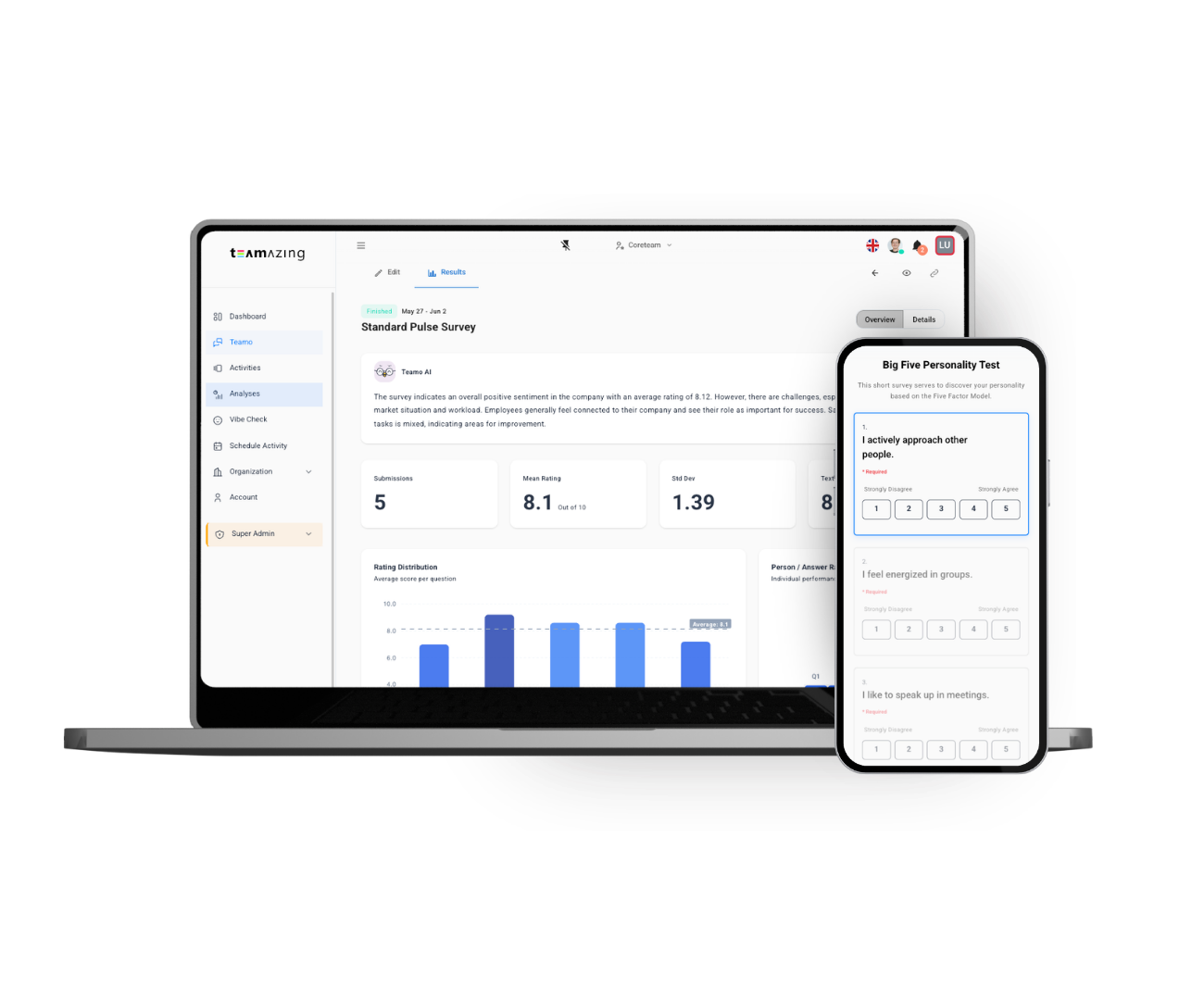
Teamo analysis platform showing survey results on laptop and mobile
Teamo AI assistant explaining analysis results

Teamo AI connects your answers, your scores and your stated ambition into an interpretation in everyday language.

How it works

1

Start the check

No account needed. Right here on this page.

2

Answer twelve questions

Everyday situations rather than jargon, about five minutes.

3

Get your result

Overall score, radar across seven fields and your two biggest levers.

About the person behind it
Robert Mack Consulting

Powered by Robert Mack Consulting

Robert Mack — strategy consulting for selling, sales and market

Robert Mack helps mid-sized companies move their sales from chance to a system. His guiding principle: sales is not everything, but without professional sales everything can quickly become nothing.

7 performance areasfrom company mission to acquisition model, in that order
Target versus actual, not gradesmeasured against your own goals, not against an industry average
Listening firstattentive listening as the prerequisite for a sustainable solution
About the company

Moving sales from chance into a system

Robert Mack Consulting works with mid-sized companies at the intersection of strategy, selling and market. Sales psychology is central: people buy emotion and trust — which is why every analysis starts with the mission and not with the close rate. Peer-level collaboration, respect and mutual trust are explicitly part of the method.

Rapid analysis in conversation

Robert Mack runs the full check personally, starting from vision and medium-term goals.

Two levers instead of seven building sites

Priority goes where a low score and genuine felt pressure coincide.

Support all the way into implementation

The evaluation produces a prioritised list of initiatives — with support if wanted.

The full Vertriebspotenzial-Check
1

Structured rapid analysis

Seven sales performance areas are assessed in a personal conversation — starting from the company's vision and its medium-term goals.

2

Target versus actual, not grades

Each area is measured against what the company itself wants to achieve. The gap in between is the potential.

3

Recommendations and implementation

The evaluation produces a prioritised list of initiatives — and, if wanted, support in implementing them.

Sales Potential Check: FAQ

Ready to get started?

Create your Vertriebspotenzial-Check in minutes — free with AI-powered analysis.

Take the Test Free