




80+ Check-in Questions for Meetings: The Right One for Every Occasion
80+ check-in questions for meetings sorted by occasion, a table for which type fits which meeting, five steps to run the round, and how to measure whether meetings improve.

Most meeting feedback asks whether people liked it. These eight ask whether the meeting did its job: clear purpose, the right people talking, a decision that survived the room.
Use this templateWhether everyone could have named the goal of the meeting before it began.
Whether the people with the relevant knowledge actually spoke, not whether everyone spoke equally.
Whether the decision is still the decision a week later, or quietly reopened in the next meeting.

I've analyzed the results and summarized the key themes — with actionable recommendations for your team.
A meeting feedback survey asks participants, right after a meeting, whether it achieved what it was for. It is deliberately not a satisfaction survey: whether people enjoyed the hour says little about whether the hour was worth it.
The eight questions below cover the things that actually decide that. Was the purpose clear before it started? Did the people who needed to speak get to speak? Was a decision made, and does anyone know what happens next? Answered by everyone in the room and read together, the pattern shows up within two or three meetings, which is much faster than anybody notices it on their own.
Start using this template for freeTeams rarely have a meeting problem. They have one or two meetings that nobody would defend and that nobody has ever measured.
The person who never speaks in the weekly is not visible in the weekly. They are visible in an anonymous survey.
The follow-up question is the one that changes behaviour: if nobody can name the next step, the meeting produced a conversation, not a decision.
Run it after the same recurring meeting three times and you have a trend line, which is much harder to argue with than a complaint.
All eight are rated on a five-point scale and take about two minutes in total.
I knew what this meeting was supposed to achieve before it started.
Purpose clarity is the cheapest fix in the list and the most common failure: an agenda item is a topic, not a goal.
The meeting was prepared well enough that we could start straight away.
Separates a preparation problem from a facilitation problem. They look identical in the room and need opposite fixes.
The people who had something relevant to say got to say it.
Deliberately not everyone spoke equally
. Equal airtime is not the goal; the relevant knowledge reaching the table is.
We made the decisions this meeting was there to make.
The single most diagnostic item. A recurring meeting that scores low here for three rounds is a status update pretending to be a decision forum.
The length of the meeting matched what we had to do.
Catches both directions. Meetings that end early and meetings that overrun are different problems, and the calendar default hides both.
The right people were in the room, and no one was there without reason.
The most expensive line item in any meeting is the invite list, and it is almost never revisited after the first invitation.
I know what happens next and who is doing it.
Where most meetings quietly fail. A decision without an owner and a date is a topic that will return.
This meeting was a good use of my time.
The summary judgement. Read it against the other seven: a high score here with a low decisions score usually means people enjoy the meeting and it achieves nothing.
A 3.5 average made of 5s and 2s is a different meeting from a 3.5 made of 3s and 4s. The first has a participation problem.
High on decisions and low on follow-up means you decide well and forget quickly. That is a documentation fix, not a meeting fix.
One round is a mood. Three rounds on the same recurring meeting is a pattern you can act on.
Your free access to templates, survey tools, and results with ways to export anywhere.
Get Started Free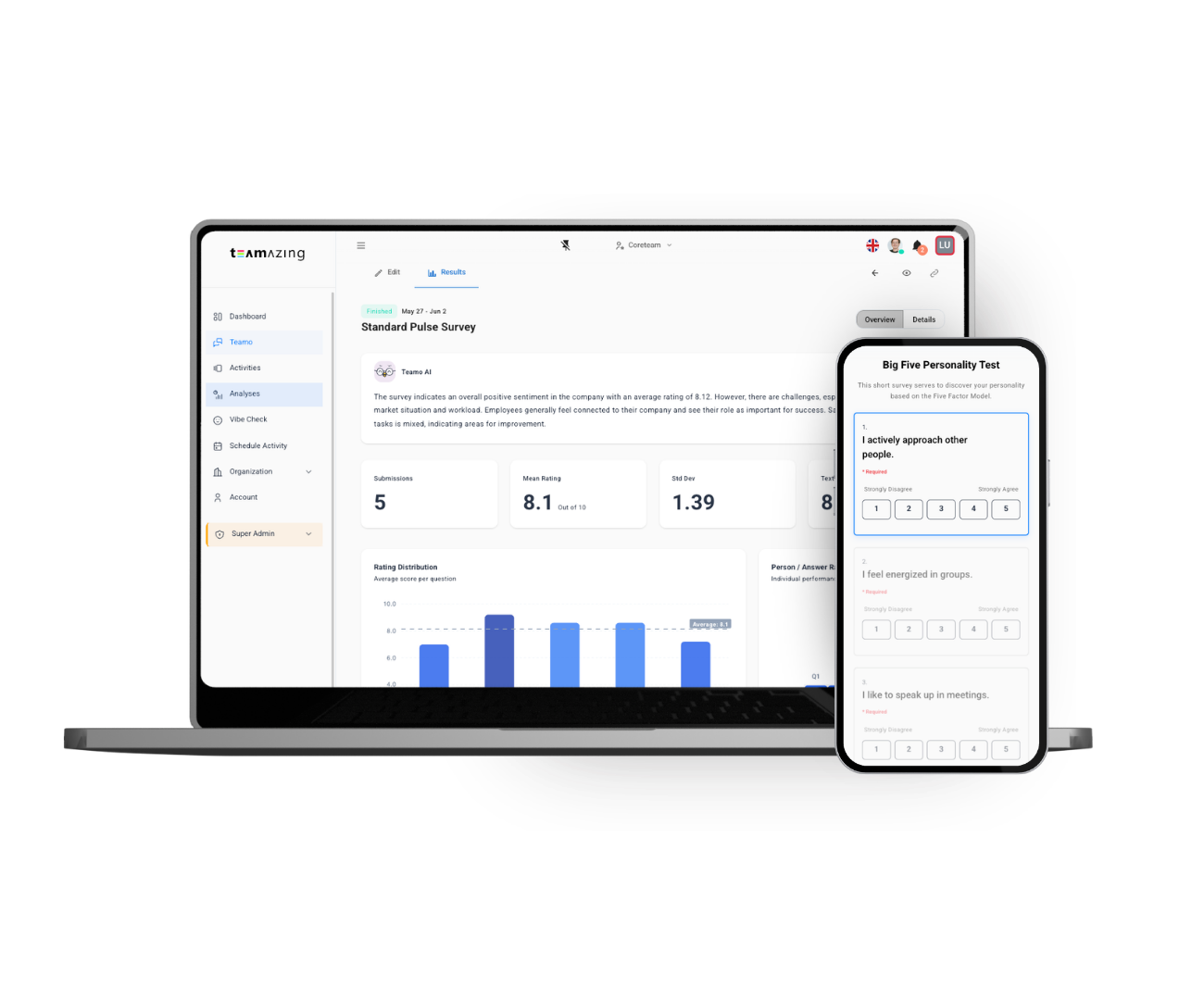
The AI analysis reads all responses together and names the two dimensions that most explain the overall score, so you get a place to start rather than eight numbers.
Pick the Meeting Feedback Survey and send it right after the meeting, while people still remember it.
Two minutes, eight questions. Anonymity matters here: the honest answer to the participation question is not one people give with their name on it.
Five minutes at the start of the next meeting. Sharing the result is itself the intervention, and it is the part most teams skip.
Find the right survey template for your team
Dive deeper with these guides

80+ check-in questions for meetings sorted by occasion, a table for which type fits which meeting, five steps to run the round, and how to measure whether meetings improve.

Why meeting rules fail, the four questions that kill a recurring meeting, a calendar audit you can run in an afternoon, and what to keep instead.

Eight questions to evaluate a meeting, what a low score on each one means, the questions that do more harm than good, and how to read the result.
Create your Meeting Feedback Survey in minutes — free with AI-powered analysis.
Use This Template Free