
Annual Performance Review Template: Free Self-Assessment with AI Summary
12 structured self-evaluation questions for meaningful year-end review conversations. 8 LIKERT ratings on goal achievement, skill development, and team contribution, plus 4 reflective open-text questions. AI generates a summary narrative so both employee and manager come to the performance appraisal prepared.
Use This Template FreeAn employee's structured evaluation of their own performance, skills, and contributions. The starting point for productive review conversations. Also called self-evaluation, self-appraisal, or employee self-review.
The belief that abilities develop through effort and learning. This is the foundation of modern performance management. Reviews built on growth mindset focus on development potential, not past failures.
A documented agreement between employee and manager on specific, measurable goals for the coming review period, typically 3-5 SMART goals. Standard practice in DACH performance management.

I've analyzed the results and summarized the key themes — with actionable recommendations for your team.
What Is an Annual Performance Review Self-Assessment?
An annual performance review self-assessment is a structured self-evaluation that employees complete before their year-end review meeting. It replaces unstructured performance appraisals with a repeatable framework covering goal achievement, skill development, team contribution, and forward-looking objectives.
Research from Gallup shows only 14% of employees feel their performance reviews inspire improvement. The problem isn't the review itself. It's the lack of preparation. When both employee and manager arrive with a structured self-evaluation in hand, the conversation shifts from rating to development. Our free template combines quantitative self-assessment (LIKERT scale) with qualitative reflection (open-text), and AI generates a narrative summary that highlights patterns, flags development areas, and suggests talking points, like having a personal review coach.
Start using this template for freeWhy Use a Structured Self-Evaluation Template?

Better Prepared, More Productive Conversations
When employees complete a structured self-evaluation before the review, both parties arrive prepared. The performance appraisal shifts from rating to development, focusing on what actually matters for growth.
Structured performance reviews improve employee satisfaction with the process by 40% (SHRM).

AI-Generated Review Summary
AI analyzes each self-assessment and creates a narrative summary: highlighting achievements, identifying development areas, and suggesting concrete talking points. Like a personal AI performance review generator for both employee and manager.
AI summaries save managers an average of 30 minutes preparation per performance review.

Growth-Oriented Question Design
Questions focus on development, future goals, and learning from challenges, not past failures. This creates psychological safety around the performance appraisal and turns the year-end review into a forward-looking dialogue.
Growth-oriented reviews increase goal achievement rates by 20% (Harvard Business Review).
Self-Evaluation Questions: The Complete Performance Review Template
12 evidence-based self-evaluation questions in two dimensions: 8 LIKERT-scale self-assessments covering goal achievement, skill development, team contribution, and satisfaction, plus 4 open-text reflections on achievements, challenges, needed support, and future goals. Use these as your annual performance review preparation checklist.
Performance & Development
I achieved my goals for the past year.
Self-assessed goal achievement often differs from manager assessment, and this gap is itself a valuable conversation starter. Tip: use the STAR method (Situation, Task, Action, Result) to prepare specific examples.
I developed new skills that are relevant to my role.
Skill development perception reveals whether employees feel they are growing or stagnating, a key driver of retention. Include this in your self-evaluation to discuss learning opportunities.
I received sufficient support for my professional development.
Development support satisfaction predicts retention: employees who feel supported are 3x more likely to stay (LinkedIn Workplace Learning Report).
I made a meaningful contribution to my team this year.
Perceived team contribution correlates strongly with engagement. People who feel they matter perform better. A strong self-assessment here provides evidence for your year-end review.
I collaborated effectively with colleagues across teams.
Cross-team collaboration is a key indicator of organizational health, and increasingly valued in performance appraisals beyond individual output.
My role and responsibilities were clearly defined.
Role clarity reduces stress and increases productivity. Ambiguity is a top driver of workplace burnout (Gallup State of the Global Workplace).
I received regular and constructive feedback from my manager.
Employees who receive weekly feedback are 5.2x more likely to strongly agree they receive meaningful feedback (Gallup). If this scores low, it's a signal to discuss Feedbackgespräch frequency.
Overall, I am satisfied with my work experience this year.
Overall satisfaction serves as a summary metric and anchor point, setting the tone for the entire performance review conversation.
Reflection & Future Planning
What was your biggest achievement in the past year?
Articulating achievements builds confidence and provides concrete evidence for your annual performance review. Use the STAR method: describe the Situation, your Task, the Action you took, and the Result.
What was your biggest challenge, and what did you learn from it?
Reflecting on challenges with a learning lens builds resilience and shifts the performance appraisal from judgment to personal growth.
What support or resources would help you perform better?
Asking for needed support turns the review into an actionable dialogue. This question often surfaces the most valuable insights for managers preparing their side of the year-end review.
What goals do you set for the coming year?
Self-set goals create 30% more commitment than assigned goals (Locke & Latham). These become the foundation for your next Zielvereinbarung (goal agreement).
How to Prepare for Your Performance Review
Complete Your Self-Assessment
Fill out the self-evaluation 1-2 weeks before your scheduled review meeting. Take 15 minutes for thoughtful, honest reflection. Be specific: use concrete examples instead of vague generalizations.
Manager Reviews AI Summary
AI generates a narrative summary highlighting self-assessed strengths, development gaps, and stated goals, giving the manager a structured preparation document for the performance appraisal.
Have the Review Conversation
Use the self-assessment as conversation foundation. Discuss alignment between self-evaluation and manager perspective, identify support needs, and agree on development priorities.
Agree on Goals Together
Combine employee-stated goals with organizational priorities. Document 3-5 SMART goals for the coming year as a shared Zielvereinbarung (goal agreement).
Free templates, survey tools & results
Your free access to templates, survey tools, and results with ways to export anywhere.
Get Started Free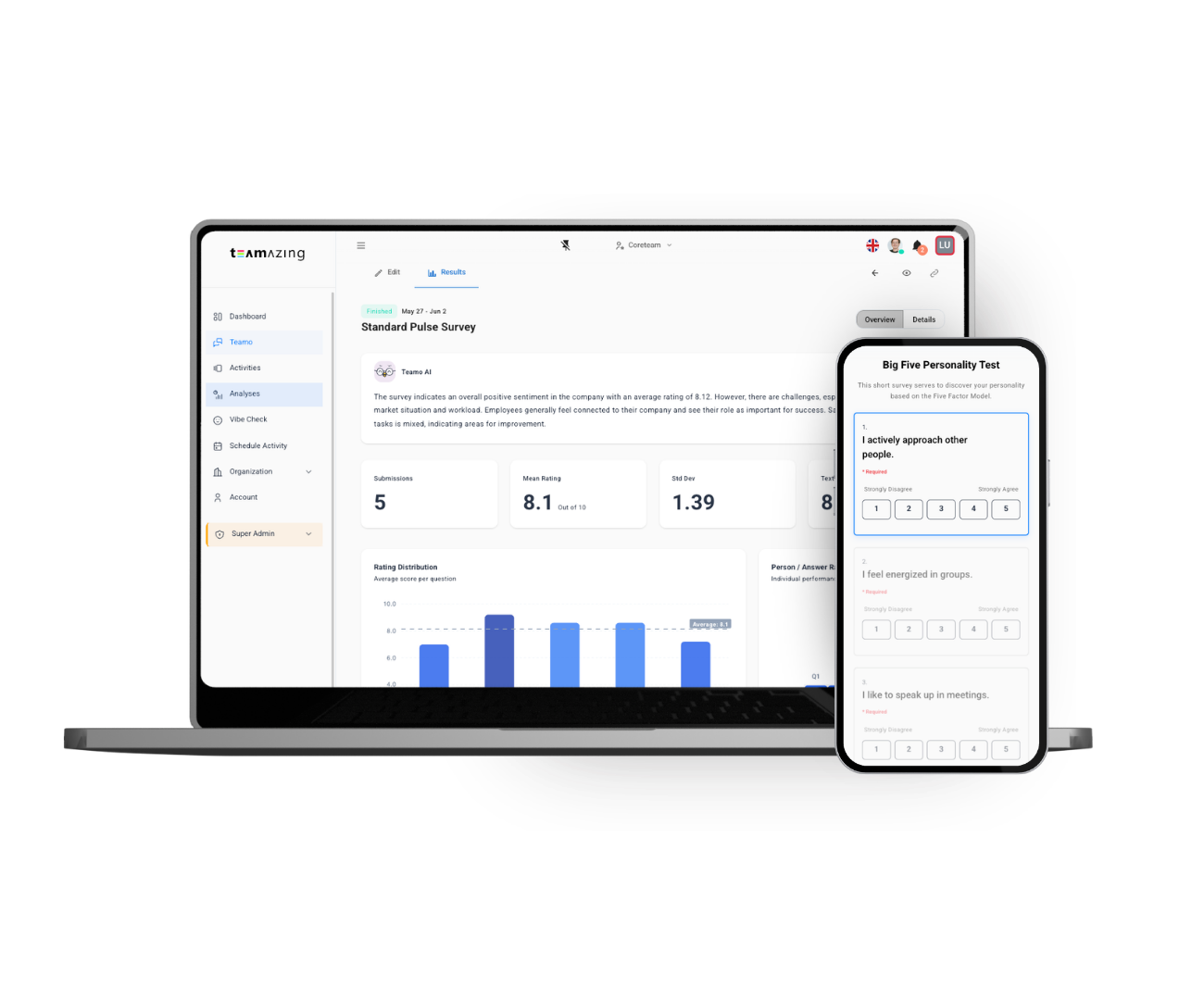
Teamo AI works like a personal performance review generator: it reads all 12 self-evaluation responses and creates a pre-meeting brief: summarizing the self-assessment narrative, flagging areas where self-rating diverges from team norms, and suggesting concrete conversation topics.
How It Works
Choose Template
Select the Annual Performance Review self-assessment template. Send it to employees 1-2 weeks before their year-end review.
15-Minute Self-Evaluation
8 LIKERT self-assessment ratings + 4 open-text reflections. Not anonymous: results go to the employee and their manager as the foundation for their performance review conversation.
AI Summary for Both Sides
AI generates a structured narrative that both employee and manager use as their review conversation foundation, replacing hours of manual preparation with an instant summary.
Annual Performance Review: Frequently Asked Questions
Explore more Templates
Find the right survey template for your team


Ready to get started?
Create your Annual Performance Review in minutes — free with AI-powered analysis.
Use This Template Free