



AI for Managers: 8 Tasks You Can Hand Off Today
AI for managers without a prompt course: 8 tasks leaders hand to AI today, a real week, limits for team data, and what it costs for teams of 5 to 200.

12 anonymous questions evaluating communication, feedback quality, development support, trust, delegation, recognition, and innovation. Teams rate their manager, AI generates a personalized coaching report with strengths and 2-3 specific development areas.
Use This Template FreeEvaluation flowing from direct reports to their manager. Also called 90-degree feedback. The reverse of traditional performance reviews. When combined with self-assessment, it becomes 180-degree feedback. Adding peer and stakeholder feedback makes it 360-degree feedback.
Team members feel safe to take risks, give honest feedback, and admit mistakes without fear of retaliation. Google's Project Aristotle identified it as the #1 factor in high-performing teams. Anonymity in manager feedback surveys is essential to protect it.
A leadership approach focused on developing team members through questions, feedback, and support rather than top-down directives. Managers who score high on coaching style see 25% better team performance within 6 months of feedback.

I've analyzed the results and summarized the key themes — with actionable recommendations for your team.
A manager effectiveness survey, also called upward feedback survey, manager evaluation, or leadership assessment, collects anonymous feedback from direct reports about their manager's leadership practices. It is the reverse of traditional top-down performance reviews: employees rate their manager on specific competencies like communication, development support, trust, and recognition.
Gallup research shows that managers account for 70% of the variance in team engagement scores. One in two employees has left a job to get away from their manager. Yet most managers receive little structured feedback from their teams. This survey bridges that gap. Our template uses 12 research-backed questions across 12 management competencies (inspired by frameworks like Google's manager feedback questions), and AI generates a personalized coaching report for each manager with specific behavioral recommendations.
Start using this template for free
Your manager is the #1 factor in your work experience. Improving manager effectiveness improves everything: engagement, retention, productivity, and team satisfaction. One in two employees has left a job because of their manager.
Managers account for 70% of variance in team engagement (Gallup). 50% of employees have left a job to get away from their manager.

AI identifies each manager's top strengths and priority development areas with specific behavioral recommendations. Each manager gets a personalized development brief, not just a score. Benchmark individual managers against the organizational average.
Targeted feedback improves manager performance by 25% within 6 months (HR research).

Minimum 3 respondents per manager ensures anonymity. Employees feel safe giving honest upward feedback about leadership behaviors they would never raise in a 1-on-1 meeting. GDPR-compliant with no personal data collected.
Anonymous manager surveys produce 40% more actionable feedback than face-to-face conversations.
12 anonymous LIKERT-scale questions, one per management competency. Covering communication, feedback, development, listening, fairness, recognition, trust, delegation, conflict resolution, role modeling, innovation encouragement, and overall satisfaction. Inspired by research-backed frameworks like Google's manager feedback survey.
My manager communicates expectations clearly.
Unclear expectations are the #1 source of workplace frustration and disengagement. This is the most fundamental management competency and often the easiest to improve with targeted coaching.
My manager gives me regular, constructive feedback.
Employees who receive weekly feedback are 5.2x more likely to strongly agree they receive meaningful feedback (Gallup). Frequency and quality of feedback are the most actionable management behaviors.
My manager truly listens to my ideas and concerns.
Active listening is the behavioral foundation of psychological safety. If employees feel unheard, engagement drops regardless of how well other management competencies score.
My manager supports my professional development.
Development support is the strongest predictor of whether high performers stay or leave. 94% of employees would stay longer if their company invested in their development (LinkedIn).
My manager treats all team members fairly.
Perceived fairness drives trust and team cohesion. If fairness scores are low, all other leadership competencies lose their impact because the foundation of trust is broken.
I trust my manager to act in my best interest.
Trust is the currency of effective leadership. Without trust, feedback is dismissed, delegation fails, and development conversations feel threatening rather than supportive.
My manager delegates effectively and empowers me to make decisions.
Delegation skill separates managers from micromanagers. Effective delegation increases team capacity and employee growth. Low scores here often indicate a control-based management style.
My manager handles conflicts constructively.
Conflict resolution ability determines whether team disagreements become productive or toxic. Managers who avoid conflict create unresolved tension that accumulates over time.
My manager leads by example and models the behaviors they expect.
Role modeling is the most powerful leadership behavior. Teams mirror their manager's behavior: if the manager works through lunch, the team feels pressure to do the same.
My manager encourages new ideas and innovative approaches.
Innovation encouragement predicts whether teams bring their best thinking or play it safe. Low scores here combined with high trust scores suggest a risk-averse management style that could be coached.
My manager recognizes and appreciates good work.
Recognition is the most cost-effective engagement lever, yet the most underutilized. Employees who feel recognized are 4x more likely to be engaged (Gallup). Many managers simply forget to acknowledge good work.
Overall, I am satisfied with my manager's leadership.
The overall satisfaction anchor validates whether specific competency improvements are actually making the leadership experience better. If individual scores are high but overall satisfaction is low, there are hidden dynamics the specific questions miss.
The 12 questions in the template produce numbers. When you evaluate a manager in writing — in the open text field of the survey, in upward feedback or as a team — you need phrasing that stays concrete and fair. Here is one example of a strength and one of a development point for each of the 7 competencies. Observation instead of judgment, behavior instead of character, and always tied to a situation you can point to.
Expectations, clarity, availability
Strength: "Expectations on outcomes and deadlines are stated clearly at every project start; questions are answered within a day."
Development point: "Priorities change often without the team hearing why. A short note on the reason would avoid duplicated work."
Regular, concrete, actionable
Strength: "Feedback arrives promptly and with a concrete reference — most recently on the client presentation, with two actionable suggestions."
Development point: "Positive feedback only comes in the annual review. A brief note after finished tasks would give more orientation day to day."
Training, career, growth
Strength: "Training requests are actively taken up; two trainings requested by the team were made possible last quarter."
Development point: "Development conversations only happen on request. A fixed half-yearly slot would keep goals from slipping out of sight."
Reliability, equal treatment, backing
Strength: "Commitments are kept, and in conflicts with other departments the manager stands in front of the team."
Development point: "Decisions on task allocation are not always traceable. Transparent criteria would strengthen the sense of equal treatment."
Handing over responsibility, leaving room
Strength: "Tasks are handed over with a clear goal and decision latitude; the how stays with the team."
Development point: "Progress on delegated tasks is checked very frequently. Agreed milestones instead of daily check-ins would allow more ownership."
Seeing and naming performance
Strength: "Good work is named individually in the team meeting, not just praised in general."
Development point: "Team successes are reported upward as department successes. Naming the people involved would raise their visibility in the company."
Allowing ideas, tolerating mistakes
Strength: "Suggestions from the team are seriously considered; two of them were implemented in the last half-year."
Development point: "Mistakes are met with more control rather than root-cause analysis. A short joint debrief would raise the willingness to try new things."
| Format | Who evaluates whom | Anonymous | Cadence | Fits when … |
|---|---|---|---|---|
| Upward feedback (manager survey) | Team → manager | Yes, from 3 responses | Half-yearly | … the manager needs an honest picture from the team |
| 360-degree feedback | Self, manager, peers, reports → one person | Yes, except self and manager view | Yearly | … you want blind spots between self-image and others' view |
| Performance review | Manager ↔ employee | No | Yearly | … one person's goals, development and performance are discussed |
Phrasing like the samples above makes an evaluation readable — the numbers from the survey make it robust. The free template on this page combines both: 12 anonymous rating questions on exactly these 7 competencies plus an open field, and AI condenses ratings and free text into one coaching report per manager. If you want to discuss the results in a conversation afterwards, the manager effectiveness guide walks through the process.
Each team rates their manager anonymously. Minimum 3 responses per manager for reliable, anonymous results. Higher response rates produce more representative insights.
AI ranks the 12 competencies from strongest to weakest for each manager and generates specific behavioral recommendations for the 2-3 lowest-scoring areas. Each manager gets a personalized development brief.
AI compares results across all managers. If recognition scores are low across the entire organization, the problem is systemic (culture), not individual. If only certain managers score low on trust, the intervention is individual coaching.
Each manager focuses on 2-3 development areas with specific behavioral goals. Re-survey in 6 months to measure improvement. Share aggregated organizational results with all leaders to normalize the feedback culture.
Your free access to templates, survey tools, and results with ways to export anywhere.
Get Started Free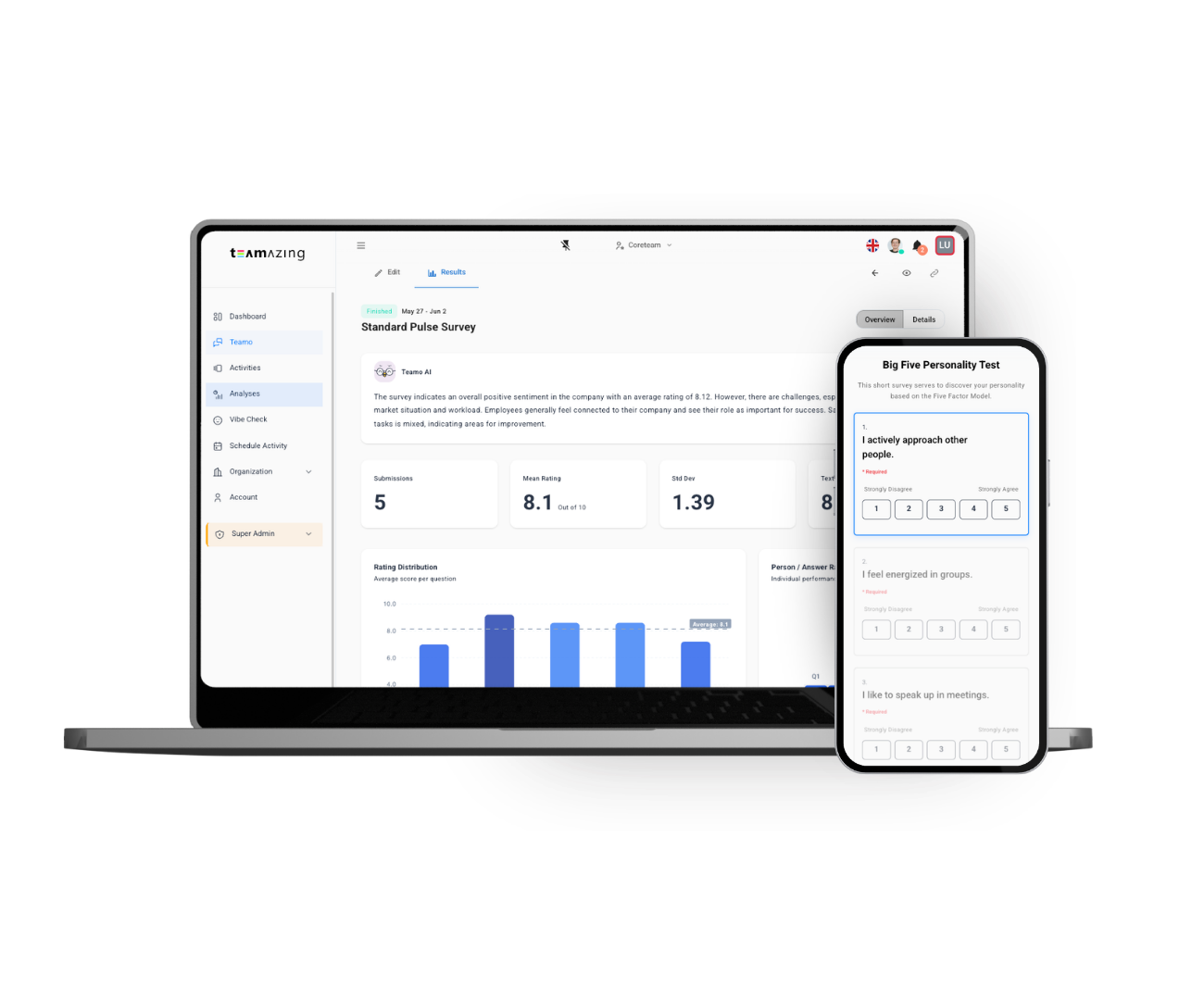
Teamo AI creates a personalized development brief per manager: highlighting strengths to leverage, 2-3 specific behaviors to practice, and how they compare to the organizational average. Over multiple survey rounds, AI tracks whether development efforts are actually moving scores.
Select the Manager Effectiveness Survey template. Assign it to specific teams. Each team evaluates their direct manager.
12 anonymous LIKERT-scale questions, 10 minutes. Minimum 3 respondents per manager ensures anonymity. GDPR-compliant.
Each manager receives a personalized AI development report with their top strengths, priority development areas, and specific behavioral recommendations.
Find the right survey template for your team
Dive deeper with these guides

AI for managers without a prompt course: 8 tasks leaders hand to AI today, a real week, limits for team data, and what it costs for teams of 5 to 200.

Four rules for employee feedback that changes behaviour: personal and concrete, data-based, recognition never in doubt, more often and shorter. Plus how to measure your feedback culture.

Real 2026 pricing for BetterUp, CoachHub, Bunch, Lattice AI, Leapsome, teamazing AI — what each tier covers, hidden costs, payback math, and the cost-effective alternative to live executive coaching.
Create your Manager Effectiveness Survey in minutes — free with AI-powered analysis.
Use This Template Free