


Free Leadership Assessment Test: 7 Tools, No Signup [2026]
Free leadership assessment test, checked in 2026: 7 tools that are genuinely free, no signup, plus what Birkman, CliftonStrengths and Korn Ferry actually cost.

Discover your leadership style in 7 minutes. Are you the visionary who inspires, the coach who develops, the democrat who includes, or the commander who directs? Based on established leadership frameworks (Goleman, Lewin). When your leadership team takes the test together, AI shows how your styles complement each other and where blind spots may exist.
Take the Test FreeYour strongest style: you lead through vision and meaning.
Secondary style: you involve the team in decisions.
Solid middle: you use targets and reward situationally.
Under-used — in a real crisis you are missing this gear.

You lead transformationally with a democratic second style — strong for change and buy-in. In a crisis you lack the commanding gear: practise deciding directively when it genuinely matters.
A leadership style test measures how you naturally lead, communicate, and make decisions. It reveals your dominant leadership approach across dimensions like vision, empathy, delegation, and decision-making speed. Knowing your style helps you lead more effectively and understand why certain team dynamics work better than others.
Our test measures the six classic leadership styles — autocratic, paternalistic, democratic, laissez-faire, transactional and transformational — scoring each from 0 to 15. These styles trace back to Kurt Lewin and the leadership research that grew out of it. If you work with Daniel Goleman's six styles: almost every classic style has a direct counterpart (transformational ≈ visionary, autocratic ≈ commanding, transactional ≈ pacesetting, democratic = democratic). The result is a profile with your primary and secondary style, your strengths, your blind spots, and the styles you have been under-using.
Start the test now
Most leaders default to one style without realizing it. The quiz reveals your dominant approach and shows where you may be over-relying on a single style. Goleman's research shows the best leaders flexibly switch between 4+ styles depending on the situation.
Leaders who use 4+ styles create the best organizational climate. Those stuck in 1-2 styles underperform (Goleman, HBR).

When your leadership team takes the quiz together, AI creates a team leadership profile showing the style distribution. A team of all Pacesetters will deliver fast but burn out. A team of all Democrats will build consensus but decide slowly. AI shows the balance and gaps.
Managers account for 70% of variance in team engagement (Gallup). Your leadership style directly shapes your team's experience.

Complete the leadership style quiz in 7 minutes. Get your primary and secondary style with practical tips for adapting to different situations. No email required, no paywall.
Based on frameworks validated across 3,000+ organizations worldwide (Goleman, Lewin, Hersey & Blanchard).
The test measures how strongly you lean on each of the six classic leadership styles — 0 to 15 points each. Each one notes its nearest Goleman equivalent in case that is the vocabulary you work with. Most leaders have one primary style and one or two secondary ones.
Autocratic: I decide alone and expect instructions to be carried out without question.
Clear hierarchy, strict control. Most effective in crises and under time pressure. Risk: morale and innovation suffer when it is the default. Goleman calls this the commanding style.
Paternalistic: I decide for my team while looking after their well-being.
Caring authority. Creates loyalty and satisfaction. Risk: limits autonomy and breeds dependence. Closest in Goleman: affiliative combined with commanding.
Transactional: I set clear targets and tie recognition to hitting them.
Performance and reward, closely tracked. Strong where work is measurable. Risk: overlooks intrinsic motivation and development. Goleman: pacesetting.
Democratic: I involve the team in decisions and build consensus.
Decisions are made together. Creates ownership and better ideas. Risk: slow, weak in a crisis. The one style Lewin and Goleman name identically.
Laissez-faire: I grant a lot of freedom and intervene as little as possible.
High autonomy, minimal steering. Strong with experienced, self-motivated teams. Risk: drift with inexperienced ones. Goleman has no such style — there it shows up as consistently low scores.
Transformational: I inspire my team with a shared vision of the future.
Leading through meaning and vision. Creates commitment and growth. Risk: charisma overshadowing day-to-day delivery. Goleman: visionary.
The six classic leadership styles are: autocratic, paternalistic, democratic, laissez-faire, transactional and transformational. These six are exactly what the test measures, scoring each from 0 to 15. Here you get every style with its core elements, advantages and drawbacks, a situational example — and its counterpart in Goleman's model in case that is the vocabulary you use.
In the test: Autocratic (0-15) · Goleman: commanding · Lewin: authoritarian
In the autocratic leadership style the leader makes decisions alone and expects instructions to be followed without question. It is characterised by a clear hierarchy and a leader who holds all the decision-making power. The style is often perceived as strict and inflexible, but it is highly efficient in certain situations: where quick decisions are needed, or where strong control and direction are required. In tightly regulated industries such as finance or healthcare it is often simply mandated.
Leader makes decisions without input from the team
Clear hierarchy and power structure
Strict control and direction
Little to no employee empowerment
Efficient in time-critical or emergency situations
Quick decision-making
Clear direction
Efficient task completion
Low employee morale
Resistance in the team
Limited innovation
In the test: Paternalistic (0-15) · Goleman: affiliative + commanding
The paternalistic leadership style combines firm decision-making authority with pronounced care for employees — leading like a caring parent. Decisions are made based on what the leader believes is best for the team, with well-being and personal development explicitly weighed in. The focus is not only on achieving goals but on creating a positive, nurturing work environment. Communication nonetheless stays largely top-down: clear guidance paired with tangible support.
Leader takes on a protective and supportive role
Decisions made in the best interest of employees
Emphasis on well-being and personal development
Top-down communication
Creating a positive and nurturing work environment
Nurturing work environment
High employee satisfaction
Strong loyalty
Limits individual autonomy
Lack of innovation
Excessive dependence on the leader
In the test: Democratic (0-15) · Goleman: democratic · Lewin: cooperative
In the democratic leadership style, leader and team decide together: team members' opinions and input count, and decisions emerge from a collaborative process. This creates ownership and commitment, because people feel their voice matters. It is especially effective where creative solutions are needed — diverse perspectives produce ideas no single person would reach alone. How systematically that participation actually works can be measured with 360-degree feedback.
Valuing the input and opinions of the team
Collaborative decision-making process
Team members feel ownership and commitment
Encouraging creative solutions
Effective for employee retention
Team ownership
High commitment
Diverse perspectives
Innovative ideas
Time-consuming
Consensus is hard to reach
Compromise can lead to suboptimal outcomes
In the test: Laissez-faire (0-15) · no Goleman equivalent
The laissez-faire leadership style largely leaves decisions to the team: the leader grants a high degree of freedom and autonomy and keeps direction and control to a minimum. People manage their own work processes — it is the opposite of micromanagement. This works particularly well with highly skilled, self-motivated individuals: they get to exercise their creativity and take real ownership. With inexperienced teams the same style quickly tips into drift.
High degree of freedom and autonomy
Minimal direction and control
Employees manage their own work processes
Effective with highly skilled, self-motivated people
Culture of innovation and self-responsibility
Employee empowerment
Creativity
Innovation
Autonomous work culture
Uncertainty about direction and priorities
Inconsistent quality
Risk of disengagement in the team
In the test: Transactional (0-15) · Goleman: pacesetting
The transactional leadership style runs on performance and reward: clear expectations, defined rewards for meeting them and consequences for falling short. Team performance is monitored closely and feedback follows pre-defined criteria. It works where tasks are clearly defined and efficiency and productivity are the priority — anywhere performance can be measured cleanly. Whether the leader is actually perceived as fair is what a manager effectiveness survey reveals.
Clear system of rewards and consequences
Setting and monitoring performance expectations (KPIs)
Feedback based on pre-defined criteria
Effective in task-bound environments
Emphasis on efficiency and productivity
Clear structure for goal achievement
Efficient task completion
Clearly defined expectations
Suppresses creativity
Overlooks intrinsic motivation
Little employee development
In the test: Transformational (0-15) · Goleman: visionary
The transformational leadership style leads through a compelling vision of the future: the leader inspires the team to look beyond self-interest and work toward a shared goal. Transformational leaders communicate that vision in a way that ignites passion and commitment, creating a durable sense of shared mission. Leaders scoring high here lead charismatically and visionarily — in Goleman's model this maps to the visionary style.
Inspiring and motivating the team
Communicating a compelling vision
Creating a sense of shared mission and purpose
Charismatic, visionary leadership
Emphasis on personal and professional growth
Inspiration and motivation
Personal and professional growth
Innovation
Shared vision
Charisma can overshadow practical management
Lack of clear direction in day-to-day work
Unrealistic visions without a solid plan
Not every leader is naturally charismatic
| Leadership style | Decision-making | Employee involvement | Communication style | Team motivation | Organisational culture |
|---|---|---|---|---|---|
| Autocratic | Leader decides without the team | Clear hierarchy and power structure | Strict control and direction | Little empowerment | Hierarchical, focused on efficiency |
| Paternalistic | Leader decides in employees' best interest | Emphasis on well-being and development | Supportive, top-down | High employee satisfaction | Supportive, family-like atmosphere |
| Democratic | Together with the team | Collaborative decision-making | Dialogue-oriented | Ownership and commitment | Participatory, diversity of opinion valued |
| Laissez-faire | The team largely decides for itself | High freedom and autonomy | Minimal direction and control | Self-managed work processes | Flexible and adaptive |
| Transactional | Along defined targets and KPIs | Clear system of rewards and consequences | Feedback on pre-defined criteria | Clear structure for goal achievement | Results-driven and structured |
| Transformational | Out of a shared vision | Engaged through purpose and mission | Inspiring and visionary | Charismatic motivation | Innovative and change-ready |
One thing becomes clear as soon as you look at leadership styles in practice: adaptability is what counts. Each of the six styles has its own strengths and weaknesses, and there is no one-size-fits-all solution. Understanding the characteristics and situational applications of each makes you a more versatile leader. It is not about adhering strictly to one style but about combining the best elements: the clear direction of the autocratic style, the care of the paternalistic, the inclusivity of the democratic and the inspiring force of the transformational. That is exactly what the leadership style test measures: not which style is right
, but which styles already come easily to you — and which ones you have been under-using. How you come across while doing it is what the DISC personality test adds.
The quiz reveals your dominant leadership style and your secondary style. Most leaders lean heavily on 1-2 styles. The goal is awareness, not judgment: every style has situations where it excels.
Each style has a strength and a risk. Pacesetters deliver results but may burn out their team. Democrats build consensus but may decide too slowly. AI highlights your specific combination and what to watch for.
When multiple leaders take the quiz, AI creates a team leadership map. A leadership team needs style diversity: Visionaries for direction, Coaches for development, Democrats for buy-in, and Commanders for crisis response. AI shows if your team has gaps.
The best leaders adapt their style to the situation. Use the results to identify which styles you underuse and practice them deliberately. Coaching underused? Schedule development conversations. Democratic underused? Involve the team in your next decision.
Your free access to templates, survey tools, and results with ways to export anywhere.
Get Started Free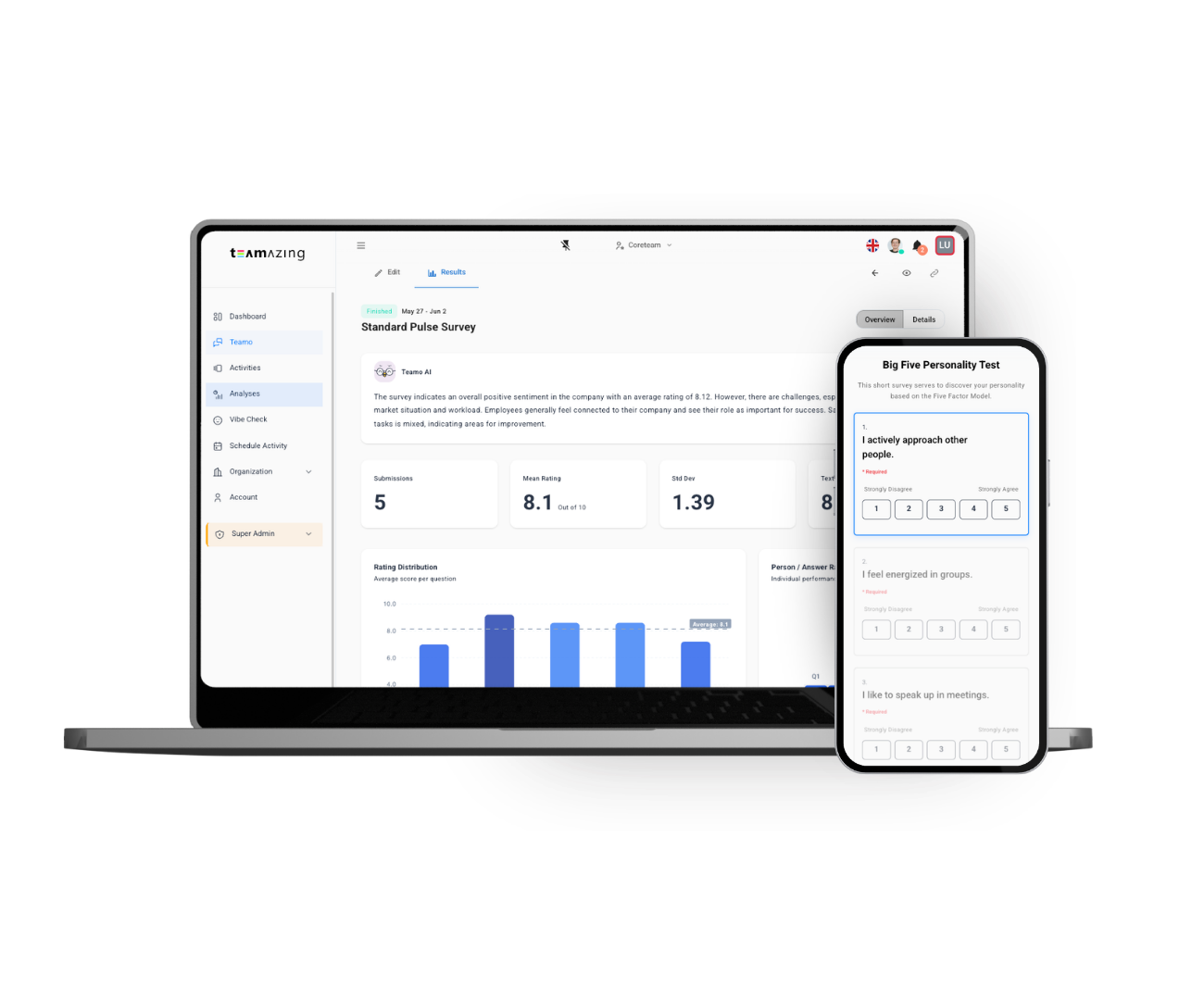
Teamo AI creates individual leadership style profiles and a team leadership composition analysis. It identifies style gaps in your leadership team and suggests which situations call for which leader to step forward based on their natural strengths.
Answer situational questions about how you lead, communicate, and make decisions. 7 minutes, no signup required.
See your primary and secondary leadership styles with strengths, blind spots, and practical tips for each situation type (crisis, development, innovation, daily operations).
When your leadership team takes the quiz, AI creates a team style map showing your collective strengths, gaps, and recommendations for which leader should take point in different scenarios.
Find the right survey template for your team
Dive deeper with these guides
![Free Leadership Assessment Test: 7 Tools, No Signup [2026]](https://www.teamazing.com/wp-content/uploads/2026/08/test-for-leaders.jpg)
Free leadership assessment test, checked in 2026: 7 tools that are genuinely free, no signup, plus what Birkman, CliftonStrengths and Korn Ferry actually cost.

Most "free AI coaching" lists hide a $59/month upgrade. Honest 2026 guide: 6 tools that are truly free, what's missing in each, and the use cases where free actually delivers manager-development outcomes.

AI for managers without a prompt course: 8 tasks leaders hand to AI today, a real week, limits for team data, and what it costs for teams of 5 to 200.
Take the Leadership Style Test now — free and in just a few minutes.
Take the Test Free