





Free DISC Personality Test: Your D, I, S or C Style in 7 Minutes

Free DISC assessment, no signup: find out in 7 minutes whether you are a decisive Driver (D), an inspiring Influencer (I), a supportive Stabilizer (S) or a precise Analyst (C) — and how you communicate, lead and collaborate. Prefer paper? The full test is also a free PDF. When your whole team takes it, AI builds a team profile of your personality mix.

Take the Test Free
Sample result
Sample result
D = Dominance (Red)78%

Direct, results-oriented, competitive, decisive. D-types focus on the bottom line and take charge. They communicate quickly and prefer action over discussion. In teams: D-types drive progress but may steamroll quieter colleagues. They need autonomy and challenges.

I = Influence (Yellow)+42

Enthusiastic, optimistic, collaborative, persuasive. I-types are the social connectors who energize groups. They communicate with warmth and stories. In teams: I-types build morale and creativity but may overlook details. They need social recognition and variety.

S = Steadiness (Green)84%

Patient, reliable, supportive, calm. S-types are the stabilizers who create harmony and consistency. They communicate thoughtfully and listen well. In teams: S-types provide stability and loyalty but may resist change. They need security and appreciation.

C = Conscientiousness (Blue)61%

Analytical, precise, systematic, quality-focused. C-types value accuracy and thoroughness. They communicate with data and logic. In teams: C-types ensure quality and catch errors but may slow decisions with over-analysis. They need clear standards and time to think.

I've analyzed the results and summarized the key themes — with actionable recommendations for your team.

What Is the DISC Personality Test?

A DISC personality test is a short behavioral assessment that sorts how you act and communicate into four styles: Dominance (D, red), Influence (I, yellow), Steadiness (S, green) and Conscientiousness (C, blue). It takes about 7 minutes, and this version is free with no signup — you rank 10 groups of four adjectives by how well they fit you and see your DISC profile immediately. Based on the model William Moulton Marston published in 1928, DISC is one of the most widely used assessment tools in the world: over 1 million people take a DISC assessment every year, and 73% of Fortune 500 companies use one.

Unlike the Big Five (which measures personality traits), DISC focuses on observable behavior and communication style. That makes it immediately practical: once you know someone is a high-D (direct, results-oriented) or a high-S (patient, supportive), you can adapt how you communicate with them. For the scientific head-to-head, read Big Five vs MBTI; for the model itself, see DISC and team roles. If you want to score by hand, the free DISC test PDF further down this page has the full question set and scoring grid.

What makes this DISC assessment different is what happens after the test: when your team takes it together, AI maps your DISC composition, shows where styles clash or complement each other, and suggests how to communicate across them.

4DISC Types
7minDuration
1-500Participants
AITeam Profile
Start the test now

Why Take the DISC Test with Your Team?

Instantly Better Communication

Instantly Better Communication

When you know your team is a mix of direct D-types and careful C-types, you stop wondering why meetings feel tense. DISC makes communication styles visible and gives everyone a shared language for collaboration preferences.

73% of Fortune 500 companies use DISC assessments. Over 1 million people take DISC tests annually.

AI Team Personality Map

AI Team Personality Map

When your team takes the test together, AI creates a DISC team map showing your type distribution. A team of mostly I-types will brainstorm brilliantly but may struggle with follow-through. A team of mostly C-types will deliver precision but may avoid risk. AI shows you the pattern and its implications.

Teams that understand their DISC composition report 25% better collaboration and communication satisfaction.

7 Minutes, Instant Results, No Signup

7 Minutes, Instant Results, No Signup

Complete the DISC test in 7 minutes and get your personality profile instantly. No email required, no paywall. See your primary and secondary DISC type with practical communication tips for working with each other type.

DISC focuses on observable behavior and communication style, making results immediately actionable in your next meeting.

The 4 DISC Personality Types (Colors)

The DISC model maps behavior on two axes: task-oriented vs. people-oriented, and active vs. reflective. This creates 4 primary types, each associated with a color. Most people are a blend of 2 types (primary + secondary). The test measures your position on each axis through agree/disagree questions about your natural behavioral preferences.

Active & Outgoing

1

I prefer to take charge and make quick decisions.

Indicates Dominance (D, Red). High agreement suggests a results-oriented, decisive communication style. D-types are natural leaders who drive progress but need to watch their pace with S and C-types who prefer more deliberation.

Likert
2

I enjoy being around people and building new relationships.

Indicates Influence (I, Yellow). High agreement suggests an enthusiastic, social communication style. I-types energize groups and build connections but may need C-types to handle the details they overlook.

Likert

Reflective & Reserved

1

I value consistency and prefer a predictable work environment.

Indicates Steadiness (S, Green). High agreement suggests a patient, supportive communication style. S-types create team harmony and reliability but may struggle with sudden changes that D-types embrace.

Likert
2

I focus on accuracy and prefer to analyze before acting.

Indicates Conscientiousness (C, Blue). High agreement suggests an analytical, precise communication style. C-types ensure quality and catch errors but may need D-types to push past analysis paralysis when decisions are needed.

Likert

The 4 DISC types in detail — Dominant, Influential, Steady, Conscientious

The four DISC types are: Dominant (the Doer), Influential (the Creator), Steady (the Connector) and Conscientious (the Analyst). They emerge from two independent dimensions — extroverted vs. introverted and task- vs. people-oriented — and these four scores are exactly what the test measures. Below you'll find each type with its core traits, strengths and weaknesses, a typical workplace example — and the team role it takes on in a project.

1

Dominant style — the Doer

In the test: D (red) · extroverted + task-oriented · team role: Doer

The dominant type pulls all the threads together: energetic, ambitious and efficient. They don't just execute tasks — they are the engine of every project, making sure the team doesn't get tangled up in planning but actually makes progress. Dominant personalities communicate directly, decide fast and naturally take the lead in ambiguous situations. You need this type on the team when pace and results matter — and a counterweight when diligence and team climate matter more.

Core elements

  • Decides fast and takes ownership

  • Direct, results-oriented communication

  • Actively drives projects forward instead of waiting

  • Seeks challenge and competition

Advantages

  • High execution speed

  • Clear direction for the team

  • Resilient under pressure

Drawbacks

  • Can come across impatient and demanding

  • Overrides objections and details

  • Risk of going it alone

2

Influential style — the Creator

In the test: I (yellow) · extroverted + people-oriented · team role: Creator

The influential type is the creative spirit of the group: enthusiastic, communicative and full of ideas. Brainstorming is second nature — they're the go-to person for anything requiring inventiveness, thriving in playful, brilliant chaos. Influential personalities effortlessly win others over for new ventures, bring energy into every meeting and think in possibilities rather than obstacles. You need this type at the start of a project — and someone who later prioritises their ideas and sees them through.

Core elements

  • Constantly generates new ideas and approaches

  • Effortlessly inspires and persuades others

  • Optimistic and open to change

  • Builds relationships and networks quickly

Advantages

  • The team's creative engine

  • Strong at pitching and presenting

  • Lifts team morale

Drawbacks

  • Loses sight of details and deadlines

  • Starts more than they finish

  • Sometimes decides impulsively

3

Steady style — the Connector

In the test: S (green) · introverted + people-oriented · team role: Connector

The steady type is the social core of the team — and often its best ambassador: they're the one sent in when a sensitive topic needs communicating. They know exactly how to handle the most diverse stakeholders, reliably set the right atmosphere and build a strong team culture on their own initiative. Steady personalities are loyal, patient and dependable; they listen before they speak and hold the team together when things get turbulent. They need lead time for change — but once decided, they support decisions for the long haul.

Core elements

  • Listens actively and mediates conflicts

  • Dependable, patient and loyal

  • Puts the team above their own ego

  • Creates trust and psychological safety

Advantages

  • Stabilises the team in stressful phases

  • Strong with stakeholders

  • Builds lasting team culture

Drawbacks

  • Avoids confrontation even when it's needed

  • Struggles with rapid change

  • Their own needs get short shrift

4

Conscientious style — the Analyst

In the test: C (blue) · introverted + task-oriented · team role: Analyst

The conscientious type holds the team's problem-solving potential: critical, detail-oriented, precise. No mistake gets past them — every decision is analysed from all angles first. That's exactly what the team values: with their watchful eye, nothing goes wrong. Conscientious personalities work in a structured way, keep standards high and deliver quality everyone can rely on. You need this type wherever accuracy counts — and someone to remind them that 90 percent on time often beats 100 percent too late.

Core elements

  • Analyses thoroughly before deciding

  • High standards of quality and accuracy

  • Works in a structured, systematic way

  • Spots risks and errors early

Advantages

  • The team's quality assurance

  • Well-founded, data-based decisions

  • Reliable on complex tasks

Drawbacks

  • Prone to perfectionism and hesitation

  • Can come across as overly critical

  • Struggles with improvisation

The 4 DISC types at a glance

DISC typeTeam roleOrientationStrength in the teamTypical phrase
Dominant (D)Doerextroverted · task-orientedPace & results“Let's just do it.”
Influential (I)Creatorextroverted · people-orientedIdeas & enthusiasm“What if …?”
Steady (S)Connectorintroverted · people-orientedCohesion & trust“How does the team feel about it?”
Conscientious (C)Analystintroverted · task-orientedQuality & precision“Have we checked that?”

Conclusion: a strong team needs all four types

No DISC type is better than another — a project stays in flow because very different characters play together: the Doer drives, the Creator supplies ideas, the Connector holds the team together and the Analyst safeguards quality. Most people actually carry a blend of two types, with one clear primary. The test shows you yours in a few minutes — and the AI team profile reveals which roles are strongly represented in your team and where a gap is looming. That makes the DISC model a great fit not just for companies, but equally for school classes, study groups or clubs.

How to Use DISC Results for Team Development

1

Individual DISC Profiles

Each participant receives their primary and secondary DISC type with practical tips for communicating with each of the other 3 types. Instantly applicable in your next meeting or project.

2

Team DISC Map

AI visualizes your team type distribution. See if your team is D-heavy (fast but may clash), I-heavy (creative but may lack follow-through), S-heavy (harmonious but may avoid conflict), or C-heavy (precise but may over-analyze).

3

Communication Playbook

AI generates specific communication recommendations for your team composition. How should a D communicate with an S? What does a C need from an I in a meeting? The playbook turns personality insights into daily collaboration habits.

4

Workshop Discussion

Use the team DISC map as a workshop activity. Share profiles, discuss communication preferences, and agree on team norms. The most valuable outcome: Now I understand why we kept misunderstanding each other.

Free templates, survey tools & results

Your free access to templates, survey tools, and results with ways to export anywhere.

Get Started Free
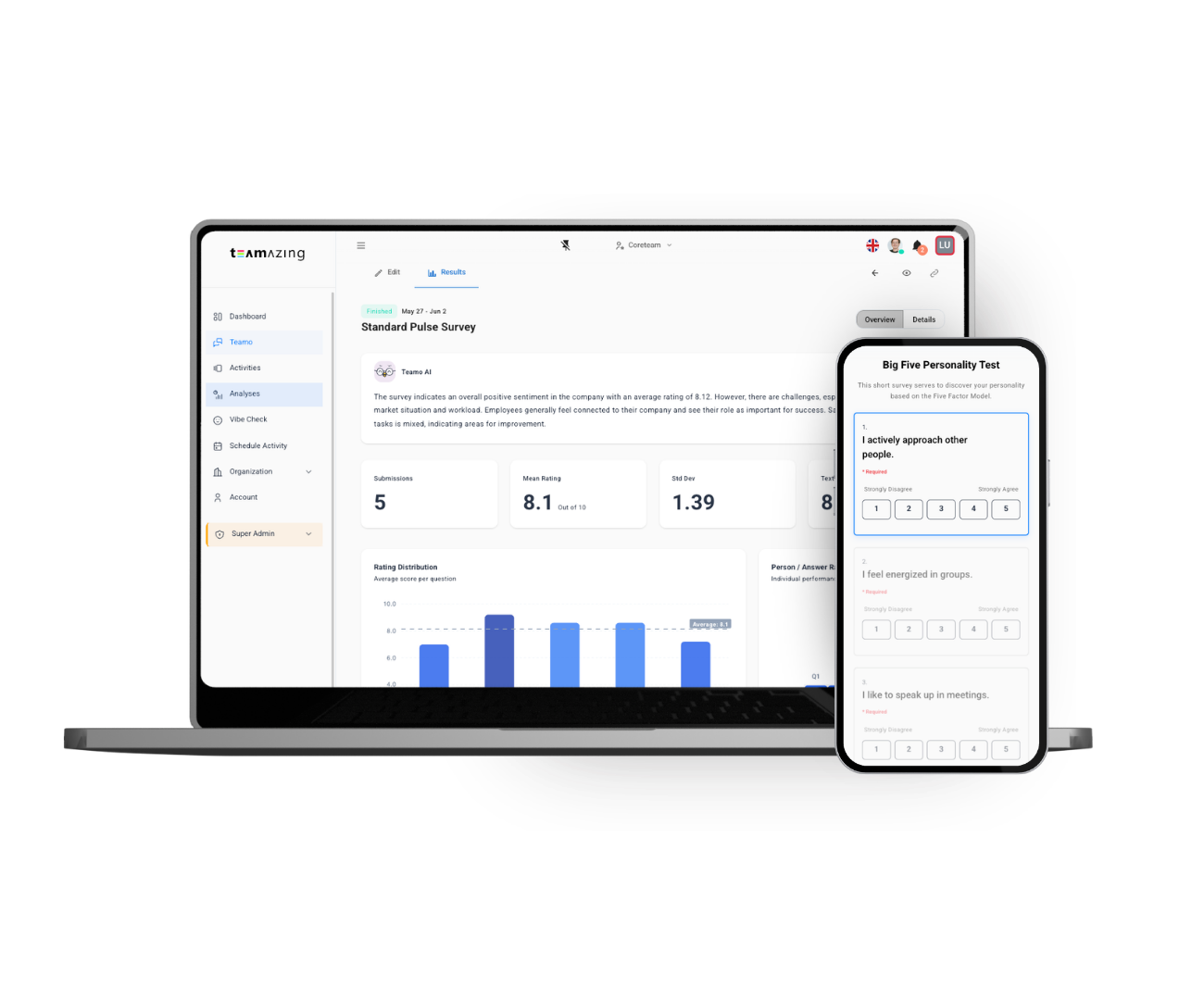
Teamo analysis platform showing survey results on laptop and mobile
Teamo AI assistant explaining analysis results

Teamo AI creates individual DISC profiles and a team composition map. It identifies communication patterns, potential friction points between types, and generates a personalized communication playbook for your specific team mix.

How It Works

1

Take the DISC Test (7 min)

Answer behavioral preference questions. The test measures your natural tendencies across the D, I, S, and C dimensions. 7 minutes, no signup required.

2

Get Your DISC Profile

Instantly see your primary and secondary DISC type with color, communication style description, strengths, blind spots, and tips for working with each other type.

3

Unlock Team Insights

When multiple team members take the test, AI creates a team DISC map with composition analysis, communication patterns, and a collaboration playbook tailored to your specific type mix.

Free DISC Test PDF: Download and Print

Yes, the full DISC test is available as a free PDF you can download, print and score by hand. No email, no signup. Two versions: the adjective-based test, where you pick the words that fit you best and least, and the situation-based assessment, where you choose how you would react. The online test above scores itself and adds an AI team profile. The PDF is for workshops, classrooms and offline sessions.

  • Adjective-based DISC test (PDF)PDF · 505 KB

    The classic word-group format: 10 groups of four adjectives. Includes the scoring grid and the D, I, S and C profile chart, so you can work out the result without a computer.

  • Adjective-based DISC test (Word)DOCX · 101 KB

    The same test as an editable document, if you want to add your own branding or adapt the wording for a workshop.

  • Situation-based DISC assessment (PDF)PDF · 249 KB

    Scenario format: each item describes a real work situation and you choose the reaction closest to yours. Better than the word list when a group finds abstract adjectives hard to rate.

  • Situation-based DISC assessment (Word)DOCX · 35 KB

    Editable version of the scenario test.

DISC Personality Test: Frequently Asked Questions

Ready to get started?

Take the DISC Personality Test now — free and in just a few minutes.

Take the Test Free