




Work-Life Balance Survey: Free Burnout Prevention Template with AI

10 anonymous questions measuring workload sustainability, flexibility, boundary management, energy, stress, and organizational support. AI generates a burnout risk assessment per team, so you can fix problems before they become sick days and resignations.

Use This Template Free
Preview
Work-Life Integration78%

The modern approach replacing rigid work-life separation with flexible blending of professional and personal responsibilities. Surveys measure whether the organization's flexibility policies actually enable this integration in practice.

Boundary Management+42

How employees create and maintain separation between work and personal life, especially in remote and hybrid settings. The 'right to disconnect' movement aims to protect these boundaries through legislation. France led with a 2017 law; DACH countries are following.

Burnout84%

Chronic workplace stress that has not been successfully managed, characterized by exhaustion, cynicism, and reduced efficacy. Classified by the WHO (ICD-11) as an occupational phenomenon. Costs employers $125-190 billion annually in healthcare (HBR).

Teamo AI assistant providing survey analysis insights

I've analyzed the results and summarized the key themes — with actionable recommendations for your team.

What Is a Work-Life Balance Survey?

A work-life balance survey, also called workload assessment, burnout prevention survey, or employee wellness questionnaire, measures how well an organization supports sustainable work patterns. It covers workload manageability, boundary respect, flexibility, stress levels, energy, and leadership support.

According to the American Psychological Association, 77% of workers report work-related stress. Poor work-life balance is the #2 reason employees quit after compensation. Yet 67% of employees hide burnout symptoms from their manager. Anonymous surveys are the only way to get the real picture. Our template uses 10 research-backed questions across 7 dimensions, and AI generates a burnout risk assessment per team based on the combination of workload, stress, and energy scores.

10Questions
7minDuration
1-500Participants
AIBurnout Risk
Start using this template for free

Why Measure Work-Life Balance?

Prevent Burnout Before It Costs You

Prevent Burnout Before It Costs You

Identify teams approaching burnout before it leads to sick days, turnover, or performance drops. The combination of high workload, low energy, and poor boundaries is the classic burnout pattern. AI catches it automatically.

Burnout costs employers $125-190 billion in healthcare annually (HBR). 76% of employees experience burnout at least sometimes (Gallup).

Data-Driven Flexibility Policies

Data-Driven Flexibility Policies

Use survey data to design flexible work policies that address real employee needs, not assumptions. Whether it is 4-day work weeks, async communication norms, or boundary protection rules: data shows what your team actually needs.

Companies with flexible policies see 25% lower turnover (Gallup). 87% of workers say flexibility would improve their balance (FlexJobs).

Anonymous, Safe & GDPR-Compliant

Anonymous, Safe & GDPR-Compliant

Employees often hide work-life struggles from managers. 67% conceal burnout symptoms. Anonymous surveys reveal the real picture that 1-on-1s and team meetings never surface.

67% of employees hide burnout symptoms from their manager. Anonymous surveys surface 2x more issues.

Work-Life Balance Survey Questions: All 10 Dimensions

10 anonymous LIKERT-scale questions across 7 work-life balance dimensions: workload sustainability, boundary respect, flexibility, leadership support, energy, stress manageability, and overall satisfaction. Research-backed, designed for quarterly pulse surveys.

Workload & Boundaries

1

I can usually complete my work within regular working hours.

The most direct measure of workload sustainability. Chronic overtime is the #1 burnout driver and the clearest signal that workload distribution needs attention.

LIKERT
2

I do not feel pressured to be available outside working hours.

After-hours pressure erodes recovery time and predicts emotional exhaustion. This question directly measures the 'right to disconnect' in practice, regardless of formal policy.

LIKERT
3

I can take breaks and use my vacation days without guilt.

Vacation guilt is a cultural indicator. If employees feel they cannot disconnect during time off, recovery fails even when the policy exists on paper.

LIKERT

Flexibility & Support

1

My organization offers enough flexibility in when and where I work.

Flexibility is the #1 requested benefit after salary. Low scores here directly predict turnover intent, especially among parents and caregivers. Measures the practical reality of work-life integration.

LIKERT
2

My manager supports my work-life balance.

Manager behavior overrides organizational policy. If the company offers flexibility but the direct manager implicitly discourages it, the policy is ineffective. This question reveals the gap.

LIKERT
3

I feel comfortable discussing workload concerns with my manager.

Psychological safety around workload conversations is the mechanism through which overload gets addressed. If employees cannot raise concerns, problems accumulate invisibly.

LIKERT
4

Our organization actively promotes sustainable work habits.

Organizational support for sustainable work distinguishes companies that genuinely prioritize balance from those that merely state it. Low scores here combined with high flexibility scores suggest 'flexibility theater'.

LIKERT

Energy & Wellbeing

1

I have enough energy for my personal life after work.

Post-work energy is the most tangible measure of work-life balance from the employee perspective. It captures the cumulative effect of workload, stress, and recovery quality.

LIKERT
2

My stress level at work is manageable for me.

Subjective stress manageability is the strongest single predictor of burnout onset, stronger than objective workload metrics. It captures the gap between demands and perceived coping resources.

LIKERT
3

Overall, I am satisfied with my work-life balance.

The overall satisfaction anchor validates whether specific dimension improvements are actually making the work-life balance experience better. If individual scores are fine but overall satisfaction is low, there are hidden stressors.

LIKERT

How to Use Work-Life Balance Survey Results

1

Send Quarterly for Trend Tracking

Send quarterly to track work-life balance trends over time. Aim for over 70% participation. Monthly pulse checks with 2-3 key questions can supplement the quarterly deep dive.

2

Identify Risk Dimensions

Dimensions scoring below 3.0 out of 5 are urgent. Between 3.0-3.5 need attention. AI highlights the burnout risk pattern: high workload + low energy + poor boundaries signals teams approaching crisis.

3

Compare Teams and Departments

AI highlights team-level differences to pinpoint where workload or culture issues are concentrated. Some teams may score well while others are struggling silently.

4

Design Targeted Interventions

Low flexibility scores may need policy changes (hybrid work, 4-day week trials). Low energy scores may need workload redistribution. Low boundary scores may need 'right to disconnect' norms. AI recommends specific interventions per dimension.

Free templates, survey tools & results

Your free access to templates, survey tools, and results with ways to export anywhere.

Get Started Free
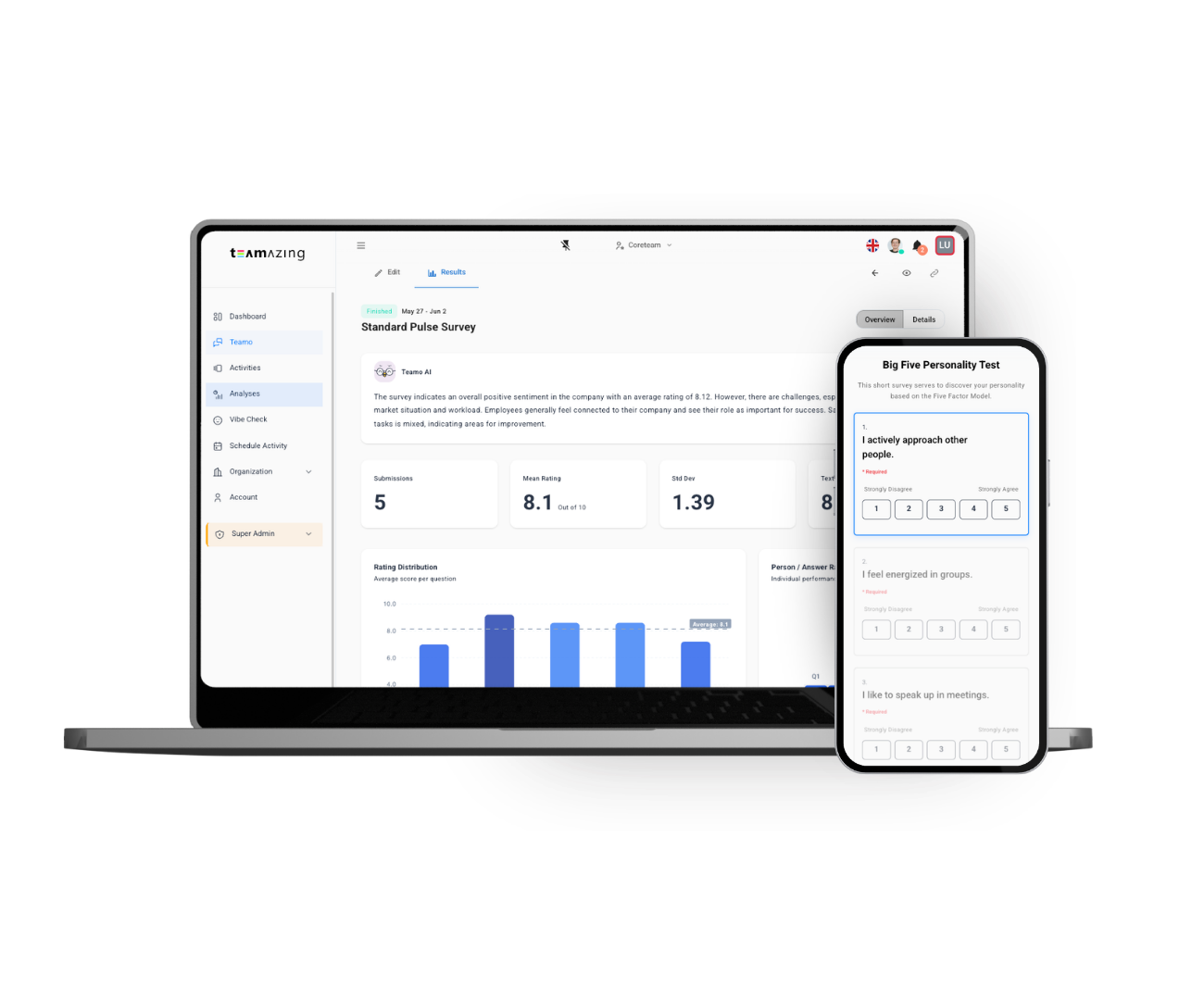
Teamo analysis platform showing survey results on laptop and mobile
Teamo AI assistant explaining analysis results

Teamo AI generates a burnout risk assessment per team based on the combination of workload, stress, and energy scores. It flags teams that need immediate intervention and recommends specific actions per dimension: policy changes for flexibility gaps, workload redistribution for overload, or boundary norms for disconnect issues.

How It Works

1

Choose Template

Select the Work-Life Balance Survey template. Send to your team or entire organization for the most complete picture.

2

7-Minute Anonymous Survey

10 anonymous LIKERT-scale questions covering all key work-life balance dimensions. Quick enough for quarterly pulse checks. GDPR-compliant, no personal data collected.

3

Get AI Burnout Risk Report

AI analyzes dimension scores, calculates burnout risk per team, compares departments, tracks quarter-over-quarter trends, and recommends specific interventions.

Work-Life Balance Survey: Frequently Asked Questions

Ready to get started?

Create your Work-Life Balance Survey in minutes — free with AI-powered analysis.

Use This Template Free