





Training Feedback Survey: 25 Evaluation Questions + Free Form

8 targeted questions evaluating training relevance, delivery quality, practical applicability, pace, materials, and interaction. Send immediately after the session. AI generates an instant report comparing results across trainers and sessions so you know exactly what to improve.

Use This Template Free
Preview
Sample result
Sample result
Kirkpatrick Model78%

The gold standard for training evaluation with 4 levels: Level 1 (Reaction, did participants like it?), Level 2 (Learning, did they learn?), Level 3 (Behavior, do they apply it?), Level 4 (Results, business impact). This survey covers Level 1 and elements of Level 2.

Training ROI+42

Measuring return on investment for learning programs, from participant satisfaction (Level 1) through behavior change to business impact. Companies with structured training feedback see 25-300% ROI on their L&D investment.

Knowledge Transfer84%

The degree to which learned skills are actually applied in daily work after training. Research shows skills not applied within 30 days are unlikely to be applied at all, making post-training feedback critical for identifying transfer barriers early.

I've analyzed the results and summarized the key themes — with actionable recommendations for your team.

What Is a Post-Training Feedback Survey?

A post-training feedback survey, also called training evaluation form, workshop feedback form, or course evaluation, measures how participants experienced a learning session. Based on Kirkpatrick Level 1 (Reaction), it captures immediate satisfaction, perceived relevance, delivery quality, and intent to apply what was learned.

ATD research shows that only 35% of organizations systematically evaluate training effectiveness, meaning most companies invest in learning and development without knowing what actually works. Our template uses 8 targeted questions covering all key dimensions, and AI generates instant reports that compare results across sessions, trainers, and topics. The result: every training gets better because feedback drives continuous improvement instead of sitting in a spreadsheet.

8Questions
5minDuration
1-200Participants
AISession Comparison
Start using this template for free

Why Collect Post-Training Feedback?

Continuous Training Improvement

Continuous Training Improvement

Each feedback round makes the next session better. Iterate on content, delivery, pace, and materials based on real participant data, not assumptions. Move beyond the Happy Sheet to actionable insights.

Training programs with systematic feedback loops improve effectiveness by 40% (ATD).

AI Cross-Session Analysis

AI Cross-Session Analysis

AI compares feedback across sessions, trainers, and topics to identify what consistently works and what doesn't, revealing patterns invisible in individual evaluations. Benchmark each training against your organization average.

Cross-session analysis reveals trainer-specific and content-specific improvement patterns invisible in single evaluations.

Quick, Non-Intrusive & Timely

Quick, Non-Intrusive & Timely

8 questions, 5 minutes. Send immediately after the training session or workshop while impressions are fresh. Feedback collected within 24 hours is significantly more accurate and detailed than delayed surveys.

Feedback collected within 24 hours is 50% more accurate than delayed post-training surveys.

Post-Training Survey Questions: All 8 Dimensions

8 LIKERT-scale questions, one per training effectiveness dimension. Covering relevance, delivery quality, practical applicability, pace, materials, interaction, expectation fulfillment, and recommendation. Based on Kirkpatrick Level 1 evaluation best practices.

Content & Relevance

1

The training content was relevant to my work.

Relevance is the #1 predictor of whether training content gets applied on the job. If participants don't see the connection to their work, knowledge transfer fails regardless of delivery quality.

Likert
2

I learned practical skills I can apply immediately.

Practical applicability separates effective training from wasted time. This question bridges Kirkpatrick Level 1 (Reaction) and Level 2 (Learning), measuring perceived readiness to apply.

Likert
3

The training materials were clear and well-organized.

Material quality affects both learning during the session and reference value afterward. Well-organized materials serve as job aids that extend the training's impact beyond the classroom.

Likert

Delivery & Interaction

1

The trainer communicated the content effectively.

Delivery quality is trainer-specific. Tracking this across sessions reveals which trainers excel and where coaching might help. The most actionable dimension for trainer development.

Likert
2

The pace of the training was appropriate.

Pace problems are the #1 complaint in training evaluations: too fast loses beginners, too slow bores experienced participants. A low score here often means the audience was poorly segmented.

Likert
3

There was enough opportunity for interaction and questions.

Interaction opportunities predict learning retention. Passive lecture formats score high on content but low on interaction. This gap reveals whether the format needs more exercises, discussions, or Q&A.

Likert

Outcome & Recommendation

1

The training met my expectations.

Expectation fulfillment measures marketing-to-delivery alignment. Low scores here often indicate a description or title mismatch rather than poor content, an easy fix with high impact.

Likert
2

I would recommend this training to colleagues.

The training NPS: recommendation intent is the strongest single predictor of actual impact. High relevance + low recommendation signals that content was good but execution needs work.

Likert

25 training evaluation questions you can copy

The 8-question form above is the fast default. When you need more — a technical training, a customer training, or a follow-up 30 days later — pick from these five groups. Mix scaled items (for trends) with one open question per block (for the why), and keep any single survey under ten questions. Scale design and the Kirkpatrick levels are covered in the training feedback survey guide.

1

After the training: the five questions that matter

Send within 24 hours · 3 scaled + 2 open

An end-of-training survey has one job: capture transfer intent and content fit while memory is fresh. Skip enjoyment questions — they predict nothing about behavior change.

Questions

  • Which part of the training will you apply first in your work? (open)

  • How well did the content match what you actually face on the job? (1–5)

  • Was the difficulty level right for your experience? (too easy / right / too hard)

  • How confident do you feel in the topic now, compared to before the training? (1–5)

  • What was missing that you expected to be covered? (open)

2

Trainer and delivery

For the trainer's own development · 4 scaled + 1 open

Delivery questions are the ones trainers actually read. Keep them concrete — "explained difficult concepts clearly" beats "was a good trainer".

Questions

  • How clearly did the trainer explain difficult concepts? (1–5)

  • Did you get enough opportunity to ask questions and practice? (1–5)

  • How well did the trainer connect the material to real situations from your team? (1–5)

  • Was the pace right — enough depth without dragging? (too slow / right / too fast)

  • What should the trainer do differently next time? (open)

3

Transfer to the job: the 30-day follow-up

The survey most companies skip — and the only one that measures impact

Behavior change happens back at work, not in the room. A short follow-up a month later tells you whether the training produced anything and what blocked it.

Questions

  • Which technique from the training have you actually used since? (open)

  • What blocked you from applying what you learned? (open)

  • Has anything measurably changed in your results — time saved, fewer errors, better outcomes? (open)

  • Did your manager follow up on the training with you? (yes / no)

  • What support would help you apply more of the training? (open)

4

Developer and technical training feedback

Hands-on labs, tooling, documentation

Technical trainings fail for different reasons than soft-skill trainings: the lab environment did not work, the examples used the wrong stack, or the docs were missing. Ask about those explicitly.

Questions

  • Did the hands-on exercises work in your environment without workarounds? (1–5)

  • How close were the examples to the stack and codebase you work in? (1–5)

  • Was the ratio of theory to hands-on time right? (too much theory / right / too much lab)

  • Which documentation, sample repo or cheat sheet would you need to continue on your own? (open)

  • Which topic needs a deeper follow-up session? (open)

5

Customer training feedback form

Product onboarding, partner enablement, certification courses

When the participants are customers, feedback doubles as a retention signal: an unclear training is the first step toward churn. Add one question about the product itself — you will learn as much about the product as about the training.

Questions

  • After this training, how confident are you using the product for your daily tasks? (1–5)

  • Which feature do you still not understand well enough to use? (open)

  • Was the training tailored to your use case or generic? (1–5)

  • How likely are you to recommend this training to a colleague? (0–10)

  • What would make you book the advanced training? (open)

When to ask which questions

MomentUse groupLengthWhat it measures
Within 24 hoursAfter the training + Trainer6–8 questionsContent fit, delivery, transfer intent
30 days laterTransfer to the job4–5 questionsActual behavior change and blockers
Technical trainingDeveloper + After the training7–9 questionsLab quality, stack fit, follow-up needs
Customer trainingCustomer form + Trainer6–8 questionsProduct confidence, fit, recommendation

Copy the questions, keep the scale

Every question above can go straight into the free form on this page — the 8-question template is the default, and you can swap or add items from the groups when you create the survey. Whatever you pick: use one scale (1–5 works for most teams), label both ends in words, and keep it identical across sessions. AI then compares trainings against each other and tells you which trainer, format or topic actually moves the numbers.

How to Analyze Training Evaluation Results

1

Send Within 24 Hours

Share the post-training survey link immediately after the session, while impressions are fresh. Delayed feedback loses accuracy as memory fades and recall becomes biased.

2

Review Dimension Gaps

High relevance but low applicability? The content is right but exercises need work. High delivery but low materials? The trainer is great but needs better handouts. AI highlights these patterns.

3

Compare Across Sessions & Trainers

AI tracks training evaluation trends across multiple sessions to show improvement over time, and benchmarks each session against your organization average. Reveals trainer-specific strengths and development areas.

4

Iterate & Improve

Use the lowest-scoring dimensions to guide specific improvements for the next session. Close the loop: share with participants what changed based on their feedback, as this increases future response rates.

Free templates, survey tools & results

Your free access to templates, survey tools, and results with ways to export anywhere.

Get Started Free
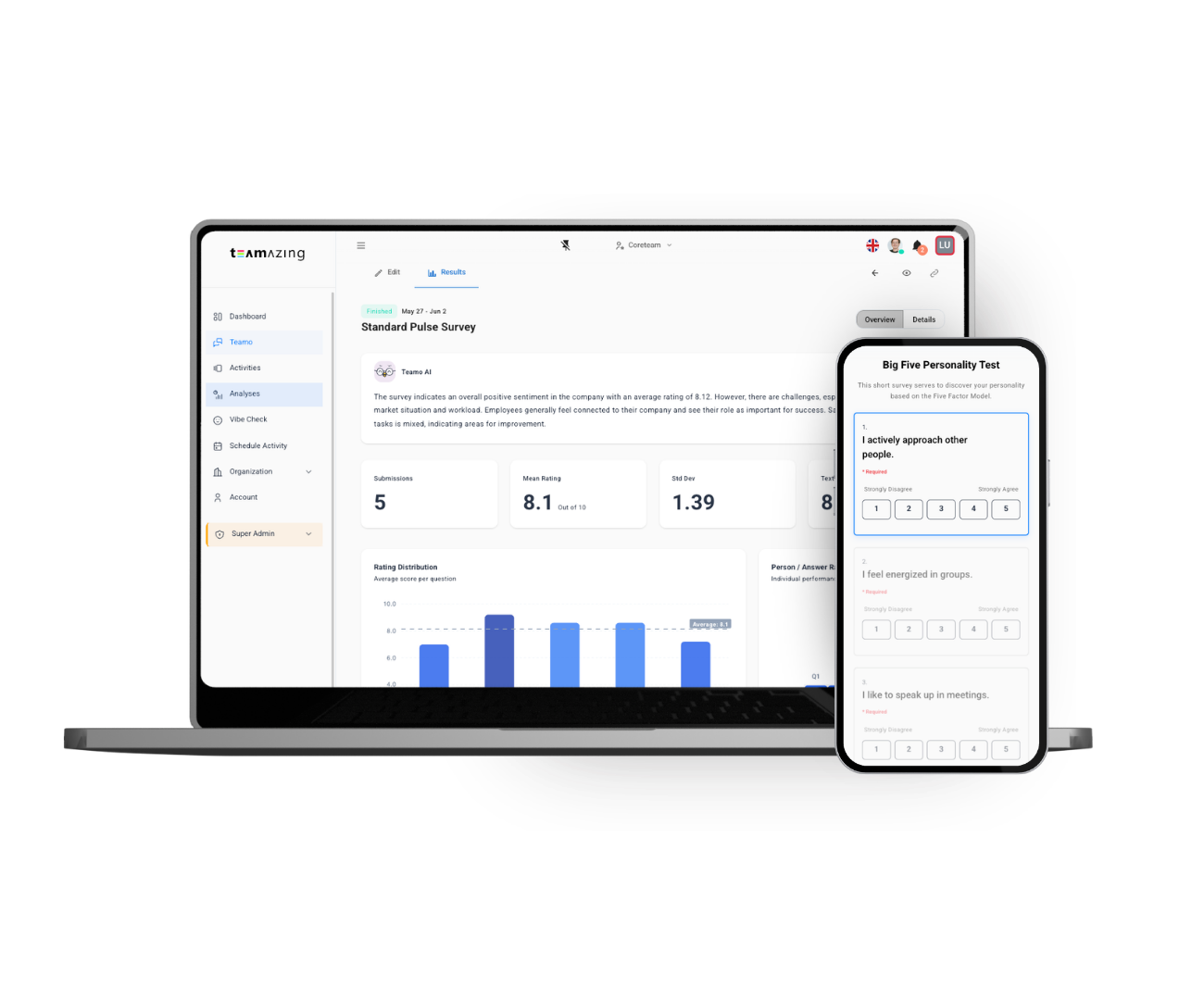
Teamo analysis platform showing survey results on laptop and mobile
Teamo AI assistant explaining analysis results

Teamo AI benchmarks each training session against your organization average and flags statistically significant deviations, so you see instantly whether this workshop or seminar was above or below par on each dimension. Over time, AI identifies which training formats, topics, and trainers consistently deliver the best results.

How It Works

1

Choose Template

Select the Training Feedback Survey template. Send to participants immediately after the training session, workshop, or seminar.

2

5-Minute Post-Training Feedback

8 quick LIKERT-scale questions covering all training effectiveness dimensions. Optional: non-anonymous for individual follow-up with participants.

3

Get AI Training Report

Instant AI analysis with dimension scores, comparison to previous sessions and trainers, and specific improvement suggestions for your next training.

Training Feedback Survey: Frequently Asked Questions

Ready to get started?

Create your Training Feedback Survey in minutes — free with AI-powered analysis.

Use This Template Free