




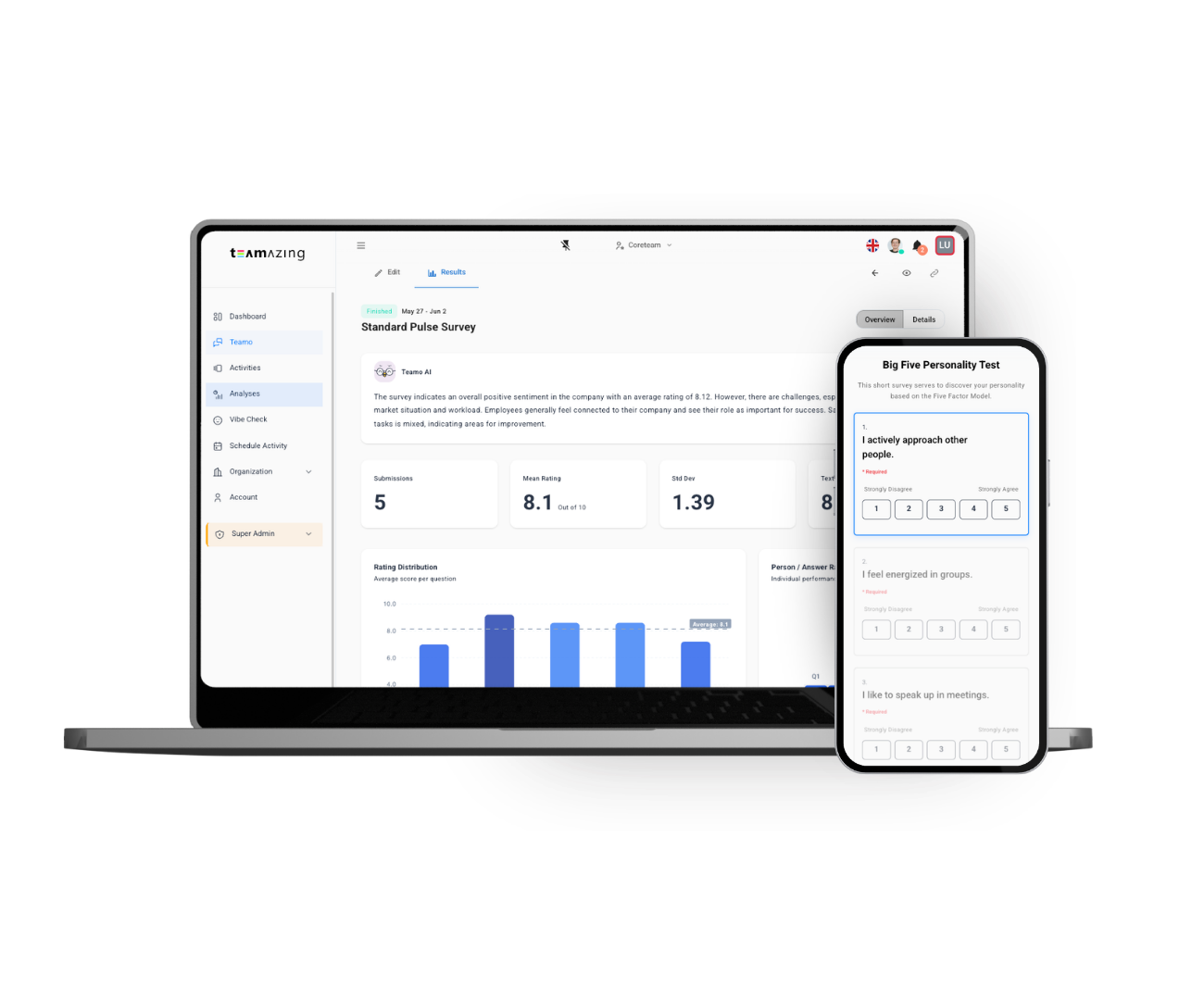
Remote Work Survey: Free Template for Hybrid and Distributed Teams
10 anonymous questions measuring equipment, communication, social connection, manager trust, productivity, meeting effectiveness, and work-life boundaries. AI identifies which remote work dimensions need attention per team, so you fix hidden friction before it becomes turnover.
Use This Template FreeA flexible work model combining remote and in-office days, typically 2-3 office days per week. Hybrid workers report the highest engagement levels across all work arrangements (Gallup 2024), but only when the setup is intentionally designed.
Communication that does not require immediate response: messages, documents, recordings. Essential for distributed teams across time zones and the key to reducing meeting overload in hybrid setups.
Fatigue caused by excessive video calls, constant notifications, and blurred work-life boundaries in remote settings. 45% of hybrid workers report meeting fatigue as a top concern. Surveys detect this before it becomes burnout.

I've analyzed the results and summarized the key themes — with actionable recommendations for your team.
What Is a Remote Work Survey?
A remote work survey, also called work from home survey, hybrid work survey, or distributed team assessment, measures how well your remote and hybrid setup supports productivity, connection, and wellbeing. It surfaces the invisible friction that remote workers rarely report on their own: bad equipment, isolation, unclear norms, meeting overload, and blurred work-life boundaries.
Buffer reports that 98% of remote workers want to continue working remotely, but 53% find it harder to feel connected to coworkers (Pew Research). Companies offering remote work see 25% lower turnover (Owl Labs), yet most never ask their teams what is actually working and what is not. Our template uses 10 anonymous questions across all key remote work dimensions, and AI generates a team report showing exactly where to invest: better tools, async communication norms, or virtual team rituals.
Start using this template for freeWhy Survey Your Remote and Hybrid Teams?
Fix Hidden Remote Work Friction
Remote workers often suffer in silence: bad equipment, isolation, unclear norms, or meeting overload. They rarely tell their manager. Anonymous surveys surface these invisible problems before they drive turnover.
67% of remote workers say they feel disconnected from colleagues (Buffer). Anonymous surveys surface 2x more issues than 1-on-1 check-ins.
AI-Powered Team Comparison
AI identifies which remote work dimensions need the most attention per team and compares fully remote, hybrid, and in-office experiences. You see exactly where to invest: better tools, communication norms, or virtual rituals.
Targeted interventions based on survey data improve remote satisfaction by 35% and reduce turnover by 25%.
Anonymous, GDPR-Compliant & Quick
Employees may not tell their manager about WFH struggles. Full anonymization gets the real picture. 10 questions in 7 minutes, designed for quarterly pulse checks without survey fatigue.
Companies save an average of $11,000 per year per remote worker (Global Workplace Analytics). A survey ensures you protect that investment.
Remote Work Survey Questions: All 10 Dimensions
10 anonymous LIKERT-scale questions, one per remote work dimension. Covering equipment, communication tools, social connection, manager trust, productivity, guidelines clarity, meeting effectiveness, work-life boundaries, tool satisfaction, and overall remote experience.
Equipment & Tools
I have the necessary technical equipment for remote work.
Equipment issues are the most fixable remote work problem, but often unreported. A low score here is a quick win: invest in monitors, headsets, or ergonomic chairs.
Our communication tools work well for remote collaboration.
Tool effectiveness directly impacts daily remote work experience. High scores on other dimensions but low tool scores means frustration is tool-driven, not cultural.
Connection & Communication
I feel connected to my team even when working remotely.
Social connection is the #1 challenge in remote and hybrid work, and the strongest predictor of remote work satisfaction. Low scores here need cultural interventions, not just better tools.
Communication within my team works well in our remote setup.
Team communication quality reveals whether your async-sync balance is right. Low scores often mean too many meetings or too little written documentation.
I trust my manager to evaluate my work fairly regardless of location.
Manager trust is the foundation of effective remote work. If employees fear 'proximity bias' (office workers getting favored), engagement drops regardless of other dimensions.
Productivity & Boundaries
I feel productive when working remotely.
Self-assessed productivity in remote settings correlates with actual output. Low scores often signal environmental problems (noise, interruptions, space) rather than motivation issues.
Our remote work guidelines and expectations are clear.
Guideline clarity reduces friction in hybrid setups. Which days in office? When to be available? When async is OK? Unclear norms create daily micro-conflicts.
Remote meetings are well-organized and effective.
Meeting effectiveness is the #1 controllable factor in remote work satisfaction. 45% of hybrid workers cite meeting fatigue as a top concern. Low scores here have a clear fix: fewer, shorter, better-prepared meetings.
I can separate work and personal life well when working remotely.
Boundary management predicts burnout risk in remote workers. Employees who struggle to disconnect work longer hours with lower output, creating a vicious cycle.
Overall, I am satisfied with my remote work experience.
The overall satisfaction anchor reveals whether individual dimension improvements are actually making the remote work experience better, or whether there are hidden factors the specific questions miss.
How to Use Remote Work Survey Results
Send Quarterly
Send the remote work survey quarterly to track how your distributed team experience evolves. After major changes (new tools, policy shifts, return-to-office decisions), run an additional pulse check.
Identify Quick Wins vs. Culture Work
Low equipment scores need quick fixes (budget approval). Low connection scores need cultural interventions (virtual rituals, team events). AI separates infrastructure problems from people problems.
Compare Remote vs. Hybrid vs. Office
AI highlights differences between fully remote, hybrid, and in-office teams on every dimension. This reveals whether your hybrid model is actually working or creating two-tier experiences.
Improve and Track Impact
Address top issues: better tools, async-first communication norms, virtual team rituals, or clearer hybrid guidelines. Track whether interventions actually move the scores in the next quarter.
Free templates, survey tools & results
Your free access to templates, survey tools, and results with ways to export anywhere.
Get Started Free

Teamo AI compares remote work scores across teams, identifies which specific interventions (tools, rituals, policies) would have the highest impact, and tracks quarter-over-quarter trends so you see whether your investments are paying off.
How It Works
Choose Template
Select the Remote Work Survey template. Send to your distributed, hybrid, or fully remote team.
7-Minute Anonymous Check-In
10 anonymous LIKERT-scale questions covering all key remote and hybrid work dimensions. GDPR-compliant, no personal data collected.
Get AI Team Report
AI generates a team report with dimension scores, remote vs. hybrid vs. office comparisons, trend tracking, and specific improvement recommendations.
Remote & Hybrid Work Survey: Frequently Asked Questions
Ready to get started?
Create your Remote Work Survey in minutes — free with AI-powered analysis.
Use This Template Free


