


Company Culture Survey: Free Template with AI Culture Map
12 anonymous questions measuring lived values, psychological safety, innovation culture, collaboration, and leadership accessibility. AI generates a visual culture map showing strengths and gaps across teams, so you know exactly where to focus your culture initiatives.
Use This Template FreeThe values employees actually experience in daily work, which often differ from official company values on the website or office walls. The gap between stated and lived values is the core metric of any culture assessment.
A shared belief that the team is safe for interpersonal risk-taking: speaking up, admitting mistakes, asking questions without fear of punishment. Google's Project Aristotle identified it as the #1 factor in high-performing teams.
Accumulated misalignment between stated culture and actual organizational behaviors, similar to technical debt but for workplace norms. Grows silently until it surfaces as turnover, disengagement, or Glassdoor reviews.

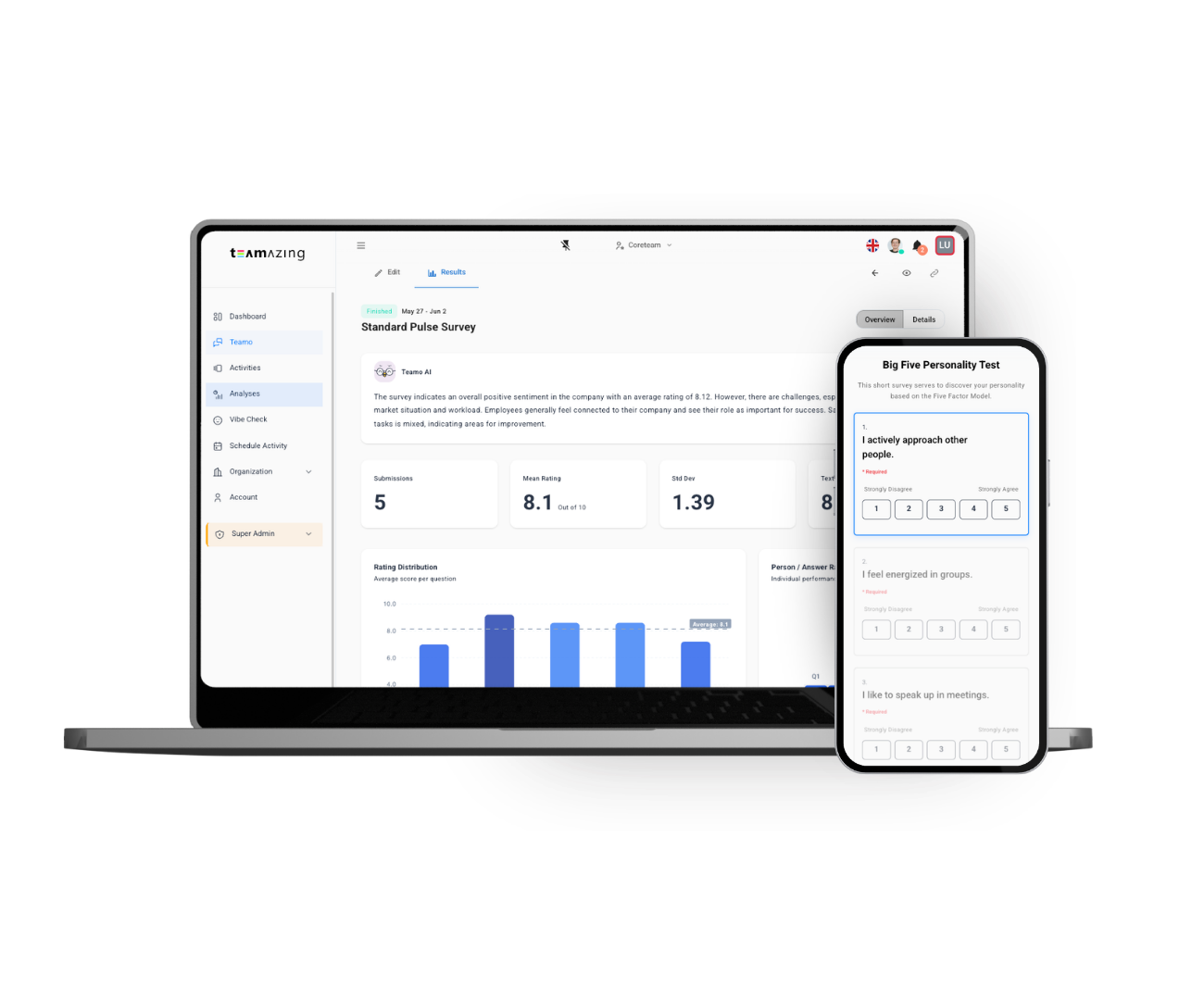
I've analyzed the results and summarized the key themes — with actionable recommendations for your team.
What Is a Company Culture Survey?
A company culture survey, also called organizational culture assessment or culture audit, measures how employees actually experience workplace culture versus how leadership intends it. It captures the gap between stated company values and daily reality across dimensions like psychological safety, innovation tolerance, transparency, and collaboration.
Deloitte research shows that 94% of executives believe culture is important for business success, but only 12% feel they truly understand their own organizational culture. Meanwhile, 92% of employees say workplace culture is a top factor in whether they stay or leave (EY). This perception gap is where culture work begins. Our free template uses 12 anonymous LIKERT-scale questions, one per culture dimension, and AI generates a visual culture map showing exactly where your strengths and blind spots are, broken down by team, department, or location.
Start using this template for freeWhy Measure Organizational Culture?
Close the Values-Reality Gap
Identify where your lived company culture diverges from stated values. This gap is the most actionable insight for leadership, because you can only improve what you can measure.
94% of executives say culture matters, but only 12% understand theirs (Deloitte).
AI-Powered Culture Map
AI creates a visual culture map showing which of the 12 dimensions are strong and which need attention, with breakdowns by team, department, or location. No manual data analysis needed.
Companies with strong culture see 72% higher employee engagement and 23% higher profitability (Gallup).
Full Anonymity for Honest Answers
Culture feedback is deeply personal. Full anonymization lets employees share what they actually experience at work, not what they think leadership wants to hear. That's how you measure real Betriebsklima.
Anonymous culture surveys yield 40% more candid responses than facilitated workshops.
Culture Survey Questions: All 12 Dimensions
12 anonymous LIKERT-scale questions, one per culture dimension. Covering values alignment, transparency, innovation, learning culture, belonging, decision-making, collaboration, growth, leadership, work-life balance, psychological safety, and overall satisfaction. Based on validated organizational culture frameworks.
Values & Transparency
Company values are lived in daily work.
The gap between stated and lived values is the single strongest indicator of organizational culture health, and the starting point for any culture initiative.
Important decisions and their reasoning are communicated transparently.
Decision transparency builds trust and reduces the rumor mill that erodes organizational culture from within.
Innovation & Learning
New ideas are encouraged and taken seriously.
Innovation culture starts with whether employees feel their ideas matter, not with innovation labs or hackathons.
Mistakes are seen as learning opportunities, not failures.
Error tolerance is the foundation of both psychological safety and innovation. Without it, people play safe and hide problems from leadership.
I have access to learning and development opportunities.
Access to professional development predicts retention: employees who feel they can grow are 3x more likely to stay (LinkedIn Workplace Learning Report).
People & Belonging
I feel a sense of belonging in my team.
Belonging is the emotional core of workplace culture. Teams with high belonging scores outperform on every engagement and retention metric.
I feel comfortable speaking up openly.
Whether people speak up or stay silent is the strongest behavioral indicator of psychological safety, the #1 factor in high-performing teams (Google Project Aristotle).
Collaboration across teams works well.
Cross-team collaboration quality reveals whether your company culture supports cooperation or reinforces organizational silos.
Leadership & Growth
My manager supports my professional growth.
The manager-employee relationship is the strongest local predictor of culture experience. Research consistently shows people don't leave companies, they leave managers.
Leadership is accessible and approachable.
Leadership accessibility correlates directly with organizational trust, and trust is the currency of healthy company culture.
I can maintain a healthy work-life balance.
Work-life balance perception is a leading indicator for burnout risk, and burnout is contagious within teams, spreading through workplace culture.
Overall, I am satisfied with the culture at my workplace.
The overall satisfaction question serves as an anchor metric. If specific dimensions score high but overall culture satisfaction is low, there are hidden issues to investigate.
How to Analyze Culture Survey Results
Run Annually, Pulse Quarterly
Culture changes slowly. Run the full 12-dimension company culture survey annually, with targeted pulse surveys on 2-3 focus dimensions each quarter to track progress.
Map Strengths and Gaps
AI creates a culture map with a traffic-light system: green (above 4.0), yellow (3.5-4.0), red (below 3.5) per dimension. Focus your energy on red dimensions first, because that's where culture debt accumulates.
Compare Across Teams
Organizational culture is not uniform. AI highlights subculture differences between departments, locations, and hierarchical levels, revealing where intervention is most needed.
Design Targeted Culture Initiatives
Focus on 2-3 red dimensions maximum. Involve employees in co-designing solutions, because top-down culture mandates rarely produce lasting change in organizational culture.
Free templates, survey tools & results
Your free access to templates, survey tools, and results with ways to export anywhere.
Get Started Free

Teamo AI creates a Culture Health Score combining all 12 dimensions into a single metric, tracking your culture transformation progress year over year. Compare teams, identify subcultures, and get concrete action recommendations.
How It Works
Choose Template
Select the Company Culture Survey template. Send it organization-wide for the most complete picture of your workplace culture.
10-Minute Anonymous Assessment
12 anonymous LIKERT-scale questions, one per culture dimension. Fully anonymous so employees share their real workplace experience, not what they think you want to hear.
Get Your AI Culture Map
AI generates a visual culture map with dimension scores, team comparisons, trend analysis, and concrete action recommendations, ready for your next leadership meeting.
Company Culture Survey: Frequently Asked Questions
Ready to get started?
Create your Culture Assessment Survey in minutes — free with AI-powered analysis.
Use This Template Free


